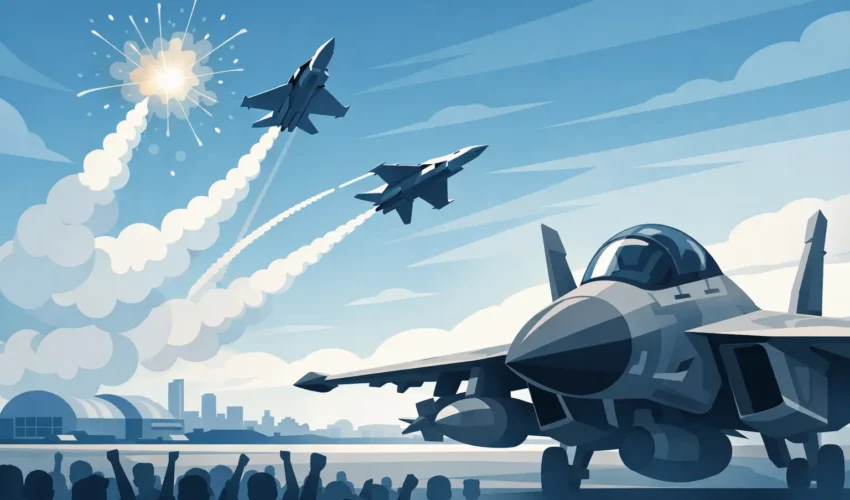

The crowd feels the jet before it sees it. A low vibration rolls across the ramp, conversations stop, and then an aircraft tears into view with enough speed and noise to make a normal flyover feel small. Military aircraft demonstrations are built around that reaction, but the best ones are more than raw horsepower. They show training, teamwork, engineering, and disciplined flying under tight limits.
For viewers who love engines, machines, competition, and high-stakes performance, an air demonstration is one of the few spectacles where all of it happens at once. A fighter can climb nearly vertical, disappear into the sun, then return in a high-speed pass that turns every camera toward the runway. A heavy transport can look almost impossible in the air. A formation team can hold spacing that seems unreal from the ground.
What You Are Really Watching
A demonstration routine may last only 10 to 20 minutes, yet every maneuver is planned around the aircraft, the crew, the airfield, the weather, and the crowd line. Nothing is improvised. Pilots rehearse specific profiles, use established minimum altitudes and distances, and make real-time calls when conditions are not right.
That discipline is what makes the action more impressive. A sharp bank is not just a photo moment. It can reveal the aircraft’s turning performance, its control response, and the pilot’s ability to place a fast-moving machine exactly where it needs to be. A slow pass by a cargo aircraft is not merely a change of pace. It puts scale on display and lets viewers see the wings, landing gear, cargo bay, and propellers working in a way a distant flight never can.
The loudest aircraft often get the biggest reaction, especially afterburner-equipped fighters. Afterburners inject fuel into the exhaust stream to deliver a major burst of thrust, producing the flame, thunder, and rapid acceleration people associate with jet demonstrations. They also consume fuel quickly, which is one reason a dramatic maneuver has to earn its place in the routine.
The Main Styles of Military Aircraft Demonstrations
Not every demonstration is a fighter-jet show. The variety is a big part of the appeal, and the best event lineups contrast speed with precision, size with agility, and modern hardware with aviation history.
Tactical fighter displays
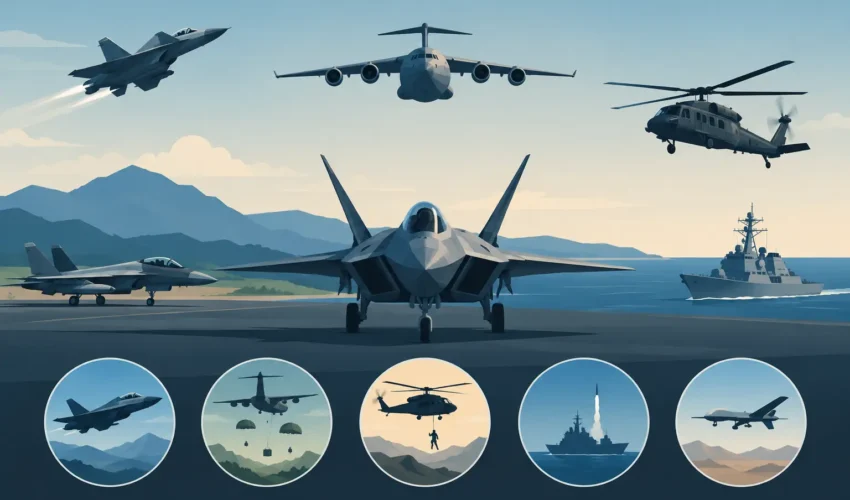
A solo fighter demonstration is usually the most aggressive part of an airshow program. Expect fast passes, steep climbs, tight turns, high-angle maneuvers, vapor trails, and occasional afterburner runs. Aircraft such as the F-16, F-22, F-35, and legacy fighters each put on a different kind of show because their designs favor different strengths.
The F-22, for example, is known for extreme agility and thrust. The F-35 demonstration often focuses on controlled slow-speed handling as well as rapid acceleration. An older fighter may not have the same stealth-era technology, but its sound, shape, and visible speed can create a more visceral crowd experience. There is no single “best” routine. It depends on whether you want brute force, maneuverability, heritage, or a close look at newer aviation tech.
Formation teams
Formation demonstrations trade the solo fighter’s unpredictably intense feel for synchronized precision. Teams fly closely grouped while completing rolls, opposing passes, loops, and crossing maneuvers. From the ground, the aircraft can look locked together. In reality, every pilot is constantly making tiny corrections while tracking speed, distance, timing, and the team leader’s cues.
The visual payoff is huge, but formation flying also tells a story about trust. These routines are not combat tactics reproduced for the crowd. They are public demonstrations of control, coordination, and the type of standardization military aviators rely on every day.
Heavy aircraft and special operations displays
Big aircraft earn their own kind of respect. A C-17 or C-130 pass can show off surprising agility for a machine built to carry troops, equipment, or supplies across long distances. Helicopter demonstrations add another dimension, hovering and turning in ways fixed-wing aircraft cannot.
Search-and-rescue scenarios, parachute jumps, cargo drops, and fast-rope displays can be especially compelling because they connect the aircraft to a mission. They give viewers a better sense of what the machine is designed to do beyond looking powerful on a runway.
Why the Best Moments Feel So Intense
Speed matters, but proximity and contrast matter just as much. A fighter flying high overhead may be technically impressive, yet a carefully managed low pass feels bigger because the audience can judge its size and velocity against the runway and the people nearby. The sound arrives with physical force. Heat shimmer distorts the view behind the engines. Suddenly, the clip on a phone does not fully capture what the crowd is experiencing.
Then there is anticipation. A good announcer can explain enough to help newcomers follow the action without talking over every moment. When the audience knows a high-speed pass or formation split is coming, the wait becomes part of the show. The aircraft vanishes, the crowd scans the horizon, and the next few seconds land harder.
Weather changes the experience too. Clear skies make it easier to follow aircraft through a full routine. Humid air can create dramatic vapor around wings during hard turns. Cloud cover may limit altitude, forcing crews to modify or shorten their profiles. Wind can affect smoke, parachute work, and formation timing. A changed routine is not a letdown when safety calls for it. It is proof that the crew is putting judgment ahead of spectacle.
How to Watch Military Aircraft Demonstrations Better
Arrive early enough to walk the static displays before the flying begins. Seeing an aircraft up close changes the scale completely. A jet that looks compact in the sky can tower over you on the ramp, while a transport’s cargo bay can make clear just how much capability fits inside its frame.
During the show, do not watch only through a phone screen. Record a few clips if you want, especially a takeoff or a dramatic pass, but take time to look up without trying to frame every second. Autofocus often struggles with fast aircraft, and your own reaction will be better than a shaky video of a jet leaving the frame.
Ear protection is a smart move, particularly for children and anyone standing near the flight line. Light layers, sunscreen, water, and a portable battery also make a long airshow day far more enjoyable. If you bring a camera, a zoom lens helps, but a wide lens is useful for formations and close ramp shots. The best setup depends on whether you want crisp aircraft detail or the bigger scene with smoke, crowd, and sky.
Respect restricted areas, barriers, and instructions from event staff. Airshow grounds are active operational spaces, not just open fields. Staying in designated viewing zones helps crews work safely and keeps everyone clear of aircraft movement.
The Difference Between Spectacle and a Sales Pitch
Military aviation events can serve several purposes at once. They entertain the public, preserve aviation heritage, support community events, recognize service members, and sometimes give potential recruits a look at a military career field. That mix is worth understanding.
The aircraft on display represent serious capability and serious public investment. It is fine to enjoy the force of a jet pass while also asking practical questions about what the aircraft does, how it is maintained, and why a particular mission needs it. The most memorable military aircraft demonstrations do not hide that complexity. They make the skill and machinery visible enough that people want to learn more.
For video fans, the best clips usually capture the full buildup: taxi lights, crew signals, the engine spool, the crowd’s pause, then the pass. A ten-second afterburner shot gets attention, but the extra context turns it into something people rewatch and share. That is the kind of aviation footage that fits naturally among the high-performance machines and action-driven videos viewers come to VIDS24 to find.
The next time an aircraft points its nose skyward, watch the details before the roar takes over. Look at how the pilot positions the aircraft, how the wing shape meets the air, and how the routine builds from one maneuver to the next. The noise gets your attention. The precision is what stays with you.