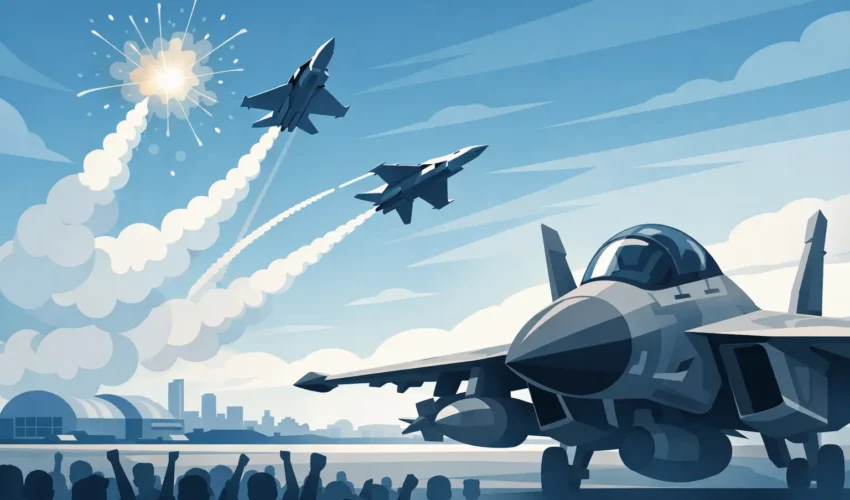
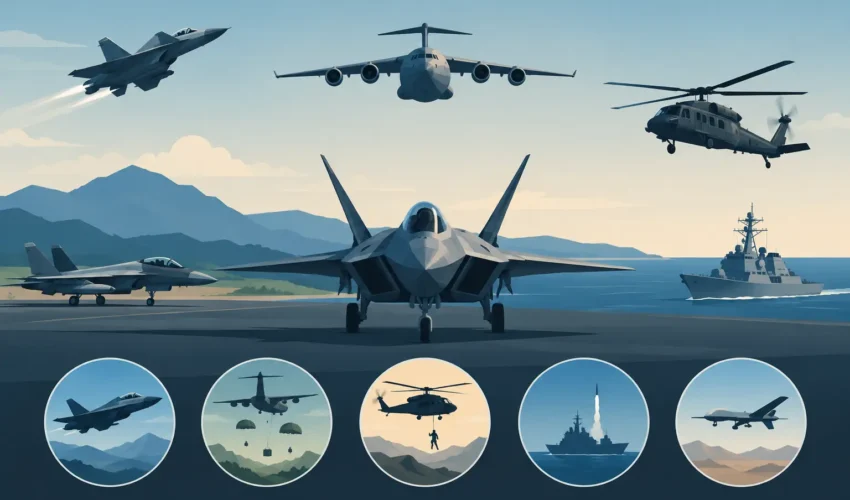

A guide to military aircraft is the fastest way to turn a loud flyover or a wild cockpit clip into something bigger than pure spectacle. That shape flashing past at hundreds of miles per hour is built for a specific job: hunting enemy aircraft, hauling troops, watching a battlefield, striking a target, or pulling a crew out of danger. The machines are dramatic. The missions behind them are even more interesting.
Military aviation is not one category. It is a full team of specialized aircraft, each balancing speed, range, payload, stealth, survivability, and cost. A jet that dominates a close-range dogfight may have little use carrying a tank across an ocean. A huge cargo aircraft can move an army’s gear, but it needs other aircraft to protect the airspace around it.
Guide to Military Aircraft: Start With the Mission
The easiest way to identify military aircraft is to ask what they are designed to do. Paint schemes, wings, engines, and weapons can offer clues, but mission comes first.
A fighter is built to gain or defend control of the sky. A bomber is built to carry a large strike payload over distance. Attack aircraft focus on supporting troops and hitting targets on the ground. Transport aircraft move people, vehicles, fuel, and supplies. Helicopters trade high speed for the ability to hover, land in tight areas, and work close to the action. Drones remove the onboard crew while extending surveillance or strike options.
There is overlap. Modern multirole fighters can conduct air-to-air combat, drop precision weapons, gather sensor data, and escort other aircraft in the same deployment. That flexibility is powerful, but it also explains why no single military aircraft does everything perfectly.
Fighters: Built for Speed, Sensors, and Air Superiority
Fighter jets are usually what people picture first. They are fast, compact, aggressive-looking, and often packed with radar, electronic warfare gear, missiles, and a cannon. Their core purpose is to find threats before those threats can reach friendly forces.
Air-superiority fighters prioritize winning control of the air. They need high performance at altitude, powerful sensors, and the ability to carry air-to-air missiles. Interceptors are a related category, designed to climb quickly and stop incoming bombers or other threats. During the Cold War, that rapid-response role shaped many famous high-speed designs.
Multirole fighters are now the centerpiece of many air forces. Aircraft such as the F-16, F/A-18, Rafale, Eurofighter Typhoon, and F-35 can be configured for different jobs. One mission may call for air-to-air missiles and extra fuel tanks. Another may require guided bombs, targeting pods, or anti-ship weapons.
Stealth fighters add another layer. Their shapes, coatings, internal weapon bays, and sensor management are intended to make detection harder, not make the aircraft invisible. Stealth is an advantage, not a force field. It works alongside electronic warfare, careful mission planning, intelligence, and support from other platforms.
When watching fighter footage, look beyond the afterburner. Notice wing shape, weapon placement, intake design, and whether the jet carries external tanks or munitions. A clean aircraft at an air show may look very different from the same jet loaded for combat.
Dogfights Are Only Part of the Story
Close-range turning fights are spectacular, but modern aerial combat often starts far beyond visual range. Radar, infrared sensors, data links, and missile range can matter before pilots ever see each other. That does not make maneuverability irrelevant. It means fighter performance is a larger package than top speed or a tight turn radius.
Bombers and Strike Aircraft: Payload Changes the Equation
Bombers are designed to deliver a serious payload at range. Heavy bombers can carry large quantities of conventional weapons and, in some nations, nuclear weapons. Their size allows for fuel, crew space, long endurance, and substantial payload capacity. The trade-off is that they are not built to mix it up like fighters.
Strategic bombers are aimed at long-range objectives, while tactical strike aircraft work closer to the battlefield. The line has blurred as precision-guided weapons have become more capable. A single modern weapon can be guided using satellite navigation, laser designation, imaging sensors, or other methods, giving commanders more options than the unguided bombing runs many people associate with older war footage.
Attack aircraft have a different flavor. They are often optimized to support troops on the ground, survive damage, and operate at lower altitudes. The A-10 is the best-known American example, built around a massive cannon and designed with significant pilot protection. It is a powerful symbol of close air support, but it also shows the reality of specialization: aircraft that operate low and slow can be extremely vulnerable in heavily defended airspace.
Helicopters: The Low-Altitude Workhorses
Helicopters bring capabilities fixed-wing aircraft cannot match. They can hover, land without a runway, follow terrain, insert teams, evacuate casualties, hunt submarines, carry supplies, and provide armed escort. Their speed is limited compared with jets, but their flexibility is unmatched in many situations.
Utility helicopters, such as the UH-60 Black Hawk, move troops and equipment. Heavy-lift helicopters carry oversized loads that would challenge trucks or require a runway for airplanes. Attack helicopters, including the AH-64 Apache, combine cannons, rockets, missiles, advanced sensors, and armored protection to support ground forces.
Naval helicopters have their own mission set. They can operate from ships, search for submarines, track surface vessels, rescue personnel, and move cargo between decks and shore. A helicopter clip may show dramatic low-level flying, but the aircraft is often performing a deliberate task: using terrain for cover, approaching a landing zone, or working around a ship’s movement and wind.
Transports and Tankers: The Aircraft That Keep Operations Moving
Fighters make headlines. Transport and tanker aircraft make large operations possible.
A strategic airlifter can move troops, armored vehicles, medical equipment, and relief supplies across continents. Tactical transports can use shorter or rougher runways to deliver cargo closer to the front. Some can airdrop supplies and paratroopers, turning the rear cargo ramp into a deployment point in midair.
Tankers extend the reach of every other aircraft. Air-to-air refueling lets fighters remain on station longer, bombers reach distant targets, and surveillance aircraft cover huge areas without landing. The process looks routine in video, but it demands precision from both crews as two large aircraft fly in close formation.
These support aircraft are not glamorous in the same way as a supersonic fighter, yet they are often the difference between a short mission and sustained airpower.
Drones and Intelligence Aircraft: The Eyes Above the Fight
Uncrewed aircraft systems, commonly called drones, range from small quadcopters to long-endurance remotely piloted aircraft. Their biggest advantage is persistence. A drone can watch an area for long periods without placing a pilot in the cockpit, depending on the system and mission.
Some drones carry cameras and sensors only. Others can carry weapons. Small drones have also changed battlefield awareness by giving units a lower-cost way to observe terrain, spot movement, and direct fire. Their limits matter too: weather, electronic interference, communications links, air defenses, and limited payload can all shape what a drone can accomplish.
Larger intelligence, surveillance, and reconnaissance aircraft gather radar imagery, signals, electronic data, and visual information. Airborne early warning aircraft, recognizable by large radar structures, help build a picture of activity across wide areas. They are less likely to star in a highlight reel, but they help commanders make sense of a crowded sky.
How to Read the Details in Military Aircraft Video
A great clip can show raw power, but context makes it better. First, identify whether the aircraft is carrying weapons, sensors, fuel tanks, cargo, or rescue equipment. Then watch its flight profile. A fighter climbing vertically, a helicopter hovering near terrain, and a transport approaching a short runway are each revealing something about the mission.
Listen for the difference between engine noise and capability. A loud fighter is memorable, but noise does not tell you its radar range, electronic warfare suite, or combat load. Likewise, a quiet-looking drone may be providing the most valuable information in the area.
Finally, be careful with labels. Online titles often call every fast jet a fighter, every armed helicopter a gunship, or every drone a combat drone. The real category can be more specific, and that detail is usually where the story gets good.
Military aircraft are built around trade-offs, not magic. The next time a video shows a jet tearing through cloud cover or a helicopter dropping into a tight landing zone, look for the mission hiding inside the moment. That is where the speed, machinery, and skill become worth watching twice.