
A clean boxing combination can look unstoppable right up until a leg kick slams into the thigh or a level change puts the striker on the canvas. That is the real divide in MMA versus boxing techniques: both sports reward timing, toughness, and sharp hands, but they operate under radically different threats. A boxer solves a fistfight. An MMA fighter has to solve a much bigger problem at full speed.
For fans watching highlight reels, the difference can be easy to miss. A knockout punch is a knockout punch, after all. But the stance that creates it, the distance required to land it, and the risks attached to throwing it change dramatically when kicks, knees, elbows, clinches, takedowns, and ground attacks are all live.
MMA Versus Boxing Techniques: The Rule Set Changes Everything
Boxing is built around punches above the belt, a defined striking range, and a referee who separates fighters after extended holding. That narrow focus lets athletes become incredibly precise. Elite boxers can spend years refining a jab, a shoulder roll, a slip-counter, or a body-shot setup against an opponent who has only two hands to threaten them.
MMA adds more weapons and more decisions. A fighter who leans too far outside a punch may run into a head kick. A deep boxing stance can leave the lead leg exposed to calf kicks. A fighter who loads up on a hook may give up an underhook, get driven to the fence, and find themselves defending a takedown instead of finishing a combination.
This does not mean boxing is less technical. It means its techniques are optimized for a specialized contest. MMA borrows heavily from boxing, then modifies those skills for a less forgiving environment.
Stance: Power, Mobility, and Takedown Defense
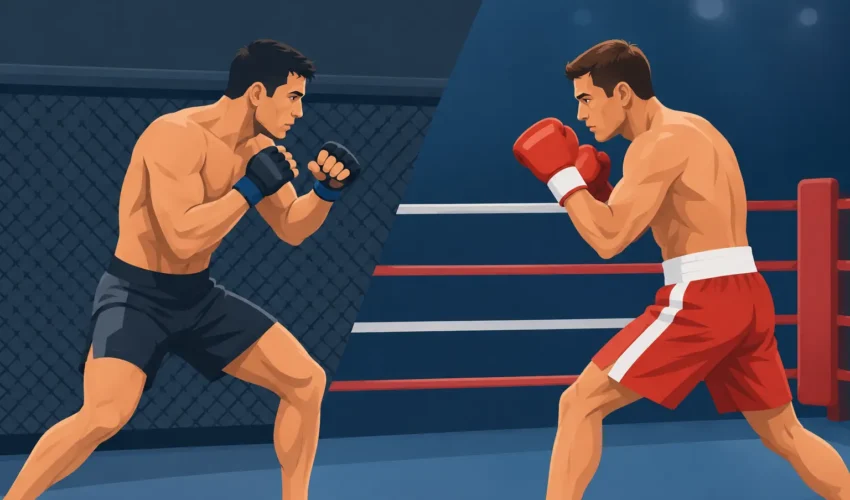
A traditional boxer often uses a bladed stance, with the lead shoulder and lead foot slightly forward. It shortens the path of the jab, helps protect the chin, and creates angles for quick exits. Weight can shift aggressively between the feet because the boxer is not expecting an opponent to attack the legs.
An MMA stance is usually more square and a little wider. The fighter needs to check kicks, move backward without crossing their feet, sprawl against shots, and stay balanced in the clinch. Hands may sit lower than in boxing because they must help defend takedowns and because an upright high guard can leave the body and legs open.
There is no single “correct” MMA stance. A pressure striker with elite wrestling may stand differently from a long-range kickboxer or a counterpuncher with dangerous jiu-jitsu. Still, the shared principle is clear: an MMA stance must keep options open.
Why a Boxing Stance Can Be Risky in MMA
The classic boxing weight shift onto the lead leg creates a target for low kicks. Heavy head movement, especially the deep slips seen in professional boxing, can also place a fighter directly in line with a knee or head kick. Pulling straight back from a punch might avoid the glove, but it can walk a fighter into the fence, where wrestling pressure becomes much harder to escape.
That said, great MMA fighters still use boxing footwork brilliantly. They just use it with an awareness of the next threat. Small pivots, controlled lateral movement, and a fast reset after punching are often more valuable than long, dramatic evasions.
Punching Mechanics: Same Weapons, Different Delivery
The jab, cross, hook, and uppercut exist in both sports. A good jab still measures range, disrupts rhythm, blinds the opponent, and opens the door for power. A cross still punishes a predictable entry. Hooks still hurt, especially when they land around a high guard or dig into the ribs.
The major difference is how freely each punch can be thrown. Boxers often chain punches in longer combinations because their opponent must remain in punching range to answer. In MMA, a three- or four-punch sequence can be enough to create a reaction, but lingering in the pocket carries extra danger.
An MMA fighter may throw a jab-cross, then immediately angle out to avoid a return kick. They may touch the body with a jab to raise the hands before shooting a double-leg. They may throw an overhand not only to hurt an opponent but to force the opponent backward onto the cage.
Boxing combinations usually pursue a punching finish. MMA combinations often pursue position. That position may be a dominant clinch, a fence pin, a takedown, or simply a safer angle from which to strike again.
Defense Is Where the Gap Gets Obvious
Boxers are masters of defensive layers. They parry, catch, block, slip, roll, pivot, clinch, and use shoulder movement to make punches miss by inches. The best make an opponent pay instantly for reaching or overcommitting.
MMA fighters need many of those tools, but they have to choose carefully. A high boxing guard can absorb punches, yet it may not stop a body kick. A tight shell near the fence can protect the head, but it can invite knees, elbows, and takedown attempts. Even the boxing clinch is different, because holding an opponent’s arms is not enough when they can lock their hands around the hips or attack with short strikes.
Distance management matters more than almost any single defensive move. At long range, kicks and front kicks are live. At midrange, punches become dangerous. At close range, elbows, knees, body locks, and trips enter the picture. On the ground, the entire fight changes again.
A boxer can afford to be excellent in one range. An MMA fighter must recognize every range before the other person does.
The Clinch Is Not a Reset in MMA
In boxing, clinching is often a survival tool. A hurt fighter ties up, takes a breath, and waits for the referee to break the action. Skilled boxers also use subtle inside control, but prolonged wrestling is not the point of the contest.
In MMA, the clinch is an attack zone. Underhooks, head position, wrist control, and pressure against the cage can decide a round. From there, fighters can throw knees to the body, short elbows, dirty-boxing punches, or takedowns. A fighter with superior boxing who freezes in the clinch can lose control of a fight fast.
This is why pure punching skill is not automatically enough in the cage. The opponent does not have to beat your hands if they can smother them, drag you into the fence, and force a grappling exchange.
How Takedowns Change Striking Choices
The threat of a takedown affects every strike before the takedown happens. A wrestler can make an opponent hesitant to plant hard on a cross. A jiu-jitsu specialist can cause a striker to avoid reckless flurries because getting tied up on the way down may lead to a submission.
Conversely, good striking makes takedowns easier. Punches force reactions. If an opponent raises their guard, straightens their posture, or retreats in a straight line, their hips may become available. The best MMA attacks blend these threats rather than treating striking and wrestling as separate sports.
That blend creates some of the most explosive moments in combat sports. A fighter stuffs a shot, lands an uppercut, turns the opponent to the fence, and finishes with knees. Another uses a hard jab to disguise a double-leg, then pounds from top position. These sequences are difficult because every action has to flow into the next one without sacrificing balance.
What Boxers Bring to MMA, and What MMA Adds
A boxer entering MMA usually brings sharp timing, reliable distance judgment, body punching, composure under fire, and the ability to spot small openings. Those are massive advantages. Clean hands remain one of the fastest ways to end a fight.
But successful adaptation requires more than learning to throw a kick. The boxer has to build a takedown defense system, learn how to stand safely after hitting the mat, become comfortable against the cage, and adjust head movement. They also need to accept that some punches should be shorter, safer, or followed by an exit rather than a prolonged exchange.
An MMA fighter who wants better boxing faces a different challenge. They need enough repetition to make their hands automatic without drifting into habits that expose them to kicks or shots. The goal is not to imitate a ring specialist move for move. The goal is to add cleaner, more efficient punching to a complete fighting game.
Train for the Contest You Actually Face
For viewers, the best way to appreciate a fight clip is to watch what happens before the knockout. Look at the feet. Notice whether the winner used a feint to draw a guard, backed the opponent to the fence, or made them worry about a takedown before the punch landed. The finish is spectacular, but the setup is the real skill.
For athletes, the lesson is even simpler: build dangerous hands, then pressure-test them against every answer the rules allow. The hardest-hitting combination means little if it leaves you off balance, trapped on the fence, or flat on your back. Train smart, respect the range, and make every strike leave you ready for what comes next.