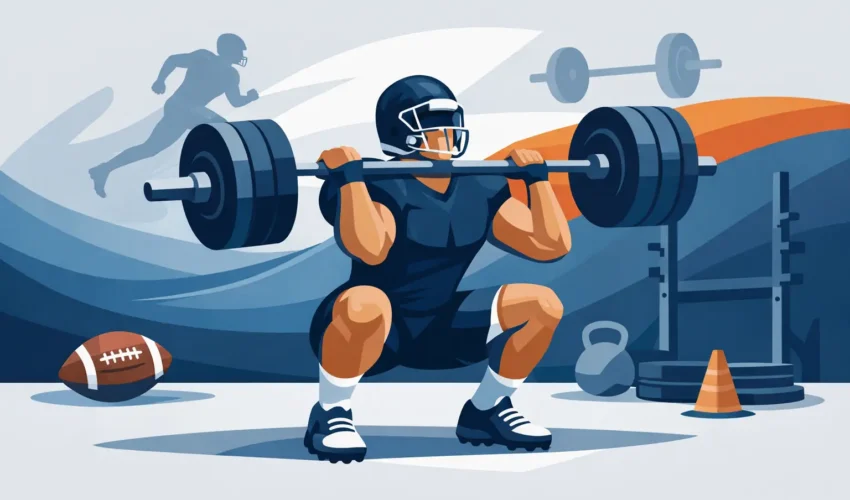

A violent clean pull, a fast extension, a bar floating high for a split second – football players Olympic lifting looks built for highlight reels. But the real question is not whether a linebacker can power clean big weight. It is whether the work makes him faster off the snap, harder to move at contact, and more durable through a long season.
Olympic lifting can be a serious weapon in a football strength program. It can also become an ego contest that eats practice time, beats up wrists and shoulders, and teaches athletes to chase numbers that do not show up on game day. The difference comes down to exercise selection, coaching, timing, and the athlete standing under the bar.
Why Football Players Olympic Lifting Gets Attention
Football is acceleration, collision, and rapid force production. A player rarely has several seconds to build strength. A defensive end has to explode from a still stance. A running back has to plant, redirect, and hit a crease before it disappears. A lineman has to create force immediately while another 300-pound athlete is trying to fold him backward.
The clean, snatch, and their variations train a fast, coordinated extension through the ankles, knees, and hips. That is the visual appeal and the potential athletic value. Done well, these movements demand intent. The athlete cannot casually muscle a clean the way he might grind out a slow squat rep.
That speed requirement is why coaches use Olympic-lift variations to develop power. The goal is not to make every football player an Olympic weightlifter. The goal is to teach and load explosive movement patterns without losing the bigger priorities: sprinting, jumping, practicing football, building strength, and staying available.
There is also a practical reason these lifts dominate training videos. Big power cleans are dramatic. They produce instant proof of aggression, athleticism, and confidence. Still, a viral lift is not automatically a smart programming decision. A perfect 315-pound clean means little if the athlete cannot decelerate, change direction, or play healthy in November.
The Transfer Is Real, but It Is Not Automatic
Olympic lifts can improve power qualities, especially when athletes have enough strength and technical skill to perform them explosively. They may help players learn to apply force quickly and coordinate their hips, trunk, and lower body under speed.
But transfer has limits. Football is played in cleats, pads, chaotic positions, and short bursts. A power clean happens on a flat platform with a predictable bar path. That does not make the clean useless. It means it belongs beside, not above, field work.
For most players, sprint exposure, jumps, throws, position drills, and heavy foundational strength work have a more direct relationship to football performance. A clean variation can support those tools. It cannot replace them.
A good rule is simple: if an Olympic lift improves the athlete’s output without stealing recovery from speed work or practice, it earns its place. If technical breakdown, soreness, or fear of missing lifts turns it into a weekly fight, choose another power exercise.
Choose the Version That Fits the Player
The full clean and full snatch are not mandatory for football. Catching a bar in a deep squat requires mobility, timing, and a larger technical investment. Some athletes thrive with it. Others get nearly all the desired training effect from a simpler variation.
Hang power cleans are a common choice because they begin from above the floor and catch in a partial squat. They can be easier to coach than full cleans while still training a sharp hip drive. Block cleans offer another controlled starting position. Clean pulls remove the catch entirely, allowing athletes to attack extension with less stress on the wrists and front-rack position.
For athletes with limited shoulder mobility, wrist pain, or a history of contact-related upper-body issues, pulls and jump shrugs can make more sense than forcing a front-rack catch. That is not a watered-down option. It is intelligent exercise selection.
The snatch deserves even more caution. Its wider grip and overhead catch can be effective for the right athlete, but it asks more of the shoulders and demands precise technique. Many football programs get better returns from clean variations, loaded jumps, medicine-ball throws, and sprint work instead of making every player chase a snatch.
Position Matters, Too
A skill player who already runs fast and needs more lower-body strength may benefit more from squats, split squats, and resisted sprints than extra clean volume. A powerful lineman with slow movement may use moderate-load pulls to train intent without adding more heavy collisions to his week.
Quarterbacks, receivers, defensive backs, and players returning from shoulder or wrist trouble need individual decisions. The barbell is a tool, not a team-wide rite of passage. The best strength staff adjusts the tool to the player rather than making the player absorb the cost of a favorite lift.
Build the Foundation Before Chasing the Barbell Clip
A player needs basic positions before loading an explosive lift. Can he hinge without rounding his back? Can she brace the trunk, control a squat, and land a jump without knees collapsing inward? Can the athlete maintain posture while accelerating and decelerating?
If those answers are not consistent, start there. Deadlifts, squats, Romanian deadlifts, lunges, jumps, and medicine-ball throws build qualities that carry into Olympic-lift progressions. A clean from the floor is not a shortcut around fundamental strength.
Technical progression should be calm and repeatable. Teach the hinge and jump pattern first. Then teach high pulls or jump shrugs. Add a rack position only when the athlete can receive the bar with stable posture and fast elbows. Training should look crisp before it looks heavy.
This is where strong coaching changes everything. The bar should stay close, the athlete should finish extension before trying to pull under, and catches should be controlled rather than collapsed. A missed rep is not a character test. It is feedback. Reset, reduce the load if needed, and make the next rep cleaner.
Load for Speed, Not for Gym Status
Football players often make a classic mistake: they turn a power movement into a strength grind. Once the bar crawls upward and the athlete has to yank it into a shaky catch, the purpose is fading.
Most Olympic-lift work for football should feature low repetitions, clean execution, and enough rest to preserve speed. Sets of one to three reps are common because they let the athlete generate force without accumulating sloppy fatigue. The exact load depends on the athlete, the variation, and the day, but the bar should move with aggression.
Heavy work has a place, particularly for experienced lifters during the offseason. Yet a personal record is not the only sign of progress. Better bar speed, cleaner positions, stronger pulls, and more consistent jumps can all signal that the program is working.
A useful weekly setup might place explosive lifts early in a lower-body session, after a thorough warm-up and before heavy squats or deadlifts. In the offseason, two exposures may work for a trained athlete. During the season, one short exposure or even a pull variation can be enough to maintain the quality without draining the legs for Friday night or Sunday.
When Olympic Lifting Is the Wrong Call
There are times to skip it. A beginner with no coaching access is better served by basic strength work, jumps, and throws than trying to learn a clean from random clips. An athlete in the middle of a brutal practice schedule may need recovery more than another explosive barbell session.
Pain is another clear signal. Wrist, shoulder, back, or knee pain should not be dismissed as part of becoming tough. Football already delivers enough punishment. Training should raise the player’s capacity to handle the sport, not add avoidable damage.
The best alternatives still train explosive intent. Trap-bar jumps, jump squats with light loads, broad jumps, box jumps performed with safe landings, sled sprints, kettlebell swings, and medicine-ball throws can deliver serious power work with a lower technical barrier. None is universally superior. The right choice depends on the athlete, equipment, coaching, and the rest of the program.
Make the Weight Room Serve Friday Night
The strongest football training culture is not the one with the loudest clean misses or the biggest social clip. It is the one where athletes run faster, strike harder, move better, and keep showing up when the season gets rough.
Football players Olympic lifting can be part of that culture when the bar moves fast, the technique is earned, and the program stays centered on football. Build the engine, respect the details, and let the explosive reps support the plays that actually matter.