
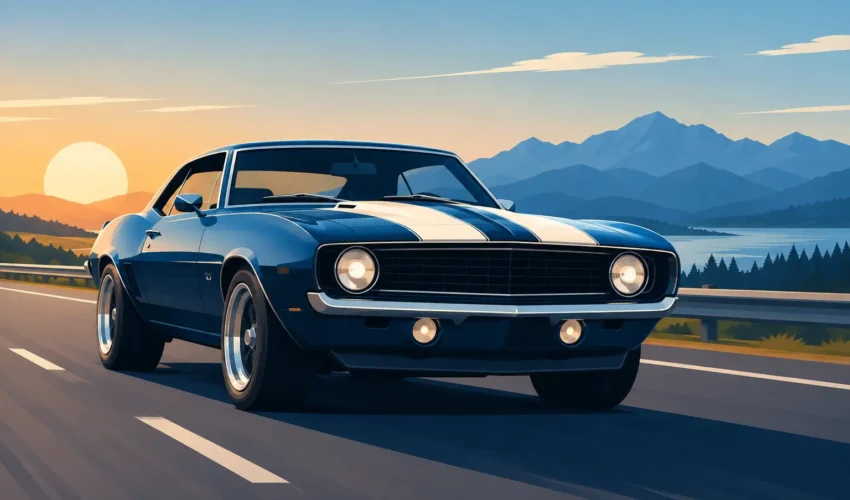

A cold start from a big V8 does not need an introduction. The idle shakes the pavement, the exhaust barks off nearby buildings, and everybody within earshot looks over. Muscle cars have always sold a feeling before they sold a spec sheet: raw power, broad shoulders, and the promise that one hard press of the throttle can turn an ordinary road into an event.
That formula has survived fuel crises, emissions rules, insurance spikes, changing tastes, and the rise of silent electric performance. It has also changed. The modern muscle car can be quicker, safer, and more capable in corners than its ancestors ever were. But the reason people crowd around one at a gas station or replay a clean burnout clip is still gloriously simple: these machines make speed feel physical.
What Makes a Muscle Car Different?
The classic recipe is American and straightforward: a powerful engine, usually a V8, in an affordable two-door coupe built for straight-line punch. Think Chevrolet Chevelle SS, Pontiac GTO, Dodge Charger, Plymouth Road Runner, Ford Torino Cobra, and the generations of Mustang, Camaro, and Challenger that followed.
There is room for debate, because car people will always debate it. A Mustang is often described as a pony car because of its smaller, sportier proportions. A Dodge Charger has four doors in several modern generations, which challenges the old two-door definition. Yet the culture sees the bigger picture. If a vehicle delivers huge torque, aggressive styling, rear-drive attitude, and a soundtrack that raises the temperature in the parking lot, it lives close to the muscle-car family.
Sports cars chase balance, braking precision, and corner exit speed. Muscle cars traditionally chase force. That does not mean they cannot handle. It means the engine is the headline, not a supporting actor.
The Muscle Cars Formula: Sound, Stance, and Torque
Horsepower figures grab attention, but torque is where the drama starts. Torque is the shove that pins you into the seat as the car moves now, not later. A big-displacement V8 delivers that shove with an ease that feels almost excessive. You do not need to run the engine to the moon to feel it working.
Then there is the visual language. Long hoods, wide fenders, hood scoops, blacked-out grilles, fat rear tires, and a stance that looks ready to launch are not accidents. They communicate performance before the key even turns. A muscle car should look like it has somewhere loud to be.
Sound is the final piece. Turbocharged six-cylinders, superchargers, and electric motors can make incredible power, but they each deliver a different kind of theater. The rumble of a naturally aspirated V8, the scream of a supercharged Hellcat, and the sharp crack of an upshift carry personality. For enthusiasts, that personality is not a minor detail. It is part of the ownership experience.
The Golden Era Was Fast, but Not Always Better
The late 1960s and early 1970s created legends for a reason. Automakers were engaged in a power war, options lists were wild, and names such as Hemi, Cobra Jet, Judge, 440 Six Pack, and LS6 sounded like challenges. These cars carried major engines, bright colors, stripes, and a level of attitude that still dominates posters, movies, auctions, and cruise nights.
But nostalgia can hide the trade-offs. Many original muscle cars had brakes that demanded planning, vague steering, limited traction, poor rust protection, and cabins that could feel rough after a long highway run. Factory horsepower ratings also do not always compare cleanly with modern ratings. The old machines were thrilling, but they were products of their time.
A current performance coupe can offer launch control, adjustable drive modes, serious cooling, powerful brakes, airbags, backup cameras, and enough horsepower to embarrass many vintage heroes. The trade-off is complexity. Modern cars rely on electronics, expensive sensors, and software-driven systems. An older V8 may be less refined, but a wrench, a shop manual, and a weekend can solve problems that a laptop cannot.
Why Modern Muscle Cars Became Performance Monsters
For years, muscle cars were dismissed as fast only in a straight line. That stereotype is no longer enough. The Chevrolet Camaro and Ford Mustang developed track-focused versions capable of serious road-course work, while Dodge turned the Challenger and Charger into tire-smoking straight-line icons with absurd factory horsepower.
This is where the category became more entertaining than ever. One buyer might want a manual-transmission Mustang for back-road runs. Another may want a supercharged Dodge built for drag-strip nights. Someone else may prefer a V8 Camaro that feels planted through high-speed corners. The badge matters, but the intended use matters more.
The numbers tell part of the story. A modern performance car can run quarter-mile times once reserved for race-prepped machines while remaining comfortable enough for a commute. That is a wild achievement. It also creates responsibility. More power does not make every driver more skilled, and public roads are not a proving ground. The best high-speed footage happens at a track, a closed course, or a properly organized drag event where there is room to make mistakes without putting strangers at risk.
The Electric Question Is Not Going Away
Electric performance cars have forced a real conversation. They deliver instant torque, repeatable acceleration, and often shocking 0-to-60 times. From a pure stoplight-to-speedometer perspective, electric power can be brutally effective.
Yet performance is more than the first few seconds of acceleration. Many enthusiasts want the vibration through the wheel, the mechanical rhythm of an engine, the shift points, and the sound that rises with speed. That is why an electric muscle car faces a tougher emotional test than a spreadsheet test.
The answer is not that one format must erase the other. Gas-powered muscle cars bring noise, ritual, and mechanical character. Electric muscle cars bring a new kind of violence: quiet at idle, then instant force when the accelerator drops. Some fans will embrace both. Others will pick a side forever. Either way, the arguments will keep car meets interesting.
Buying Muscle Cars Without Buying a Headache
The right car depends on whether you want a weekend cruiser, a project, a showpiece, a drag-strip regular, or a daily driver with a bad attitude. A clean classic can cost more upfront but save a painful restoration later. Cheap project cars often become expensive projects once rust, wiring, drivetrain condition, and missing trim enter the picture.
For a modern model, look beyond peak horsepower. Check maintenance records, tire condition, brake wear, modifications, insurance costs, fuel requirements, and whether the car has been abused. A heavily modified car may be genuinely well built, but it may also have been launched, drifted, and tuned beyond what its supporting parts can handle. Stock or lightly modified examples are usually easier to evaluate.
Before buying, drive the car at low speed as well as hard acceleration. Pay attention to visibility, seat comfort, transmission behavior, steering feel, and heat inside the cabin. The car that wins a five-second video may not be the car you want to live with for five years.
Why the Culture Still Pulls People In
Muscle-car culture is bigger than the vehicle itself. It is garage builds, father-and-daughter projects, late-night meets, dyno pulls, drag racing, restoration channels, road trips, and the moment a stranger recognizes the sound of your engine before they see the car. It welcomes collectors with rare originals and younger drivers saving for their first V8.
That range is why the content never gets old. One video might feature a numbers-matching 1970 Chevelle rolling out of a trailer. The next might show a modern Mustang putting down a serious lap, a Charger making a clean pass at the strip, or a home builder bringing a neglected classic back to life. On VIDS24, that mix of machinery, speed, skill, and surprise is exactly what makes automotive footage worth watching twice.
The best muscle car is not automatically the rarest, loudest, or most expensive one. It is the one that makes you want to take the long way home, learn how it works, and give its power the respect it demands.