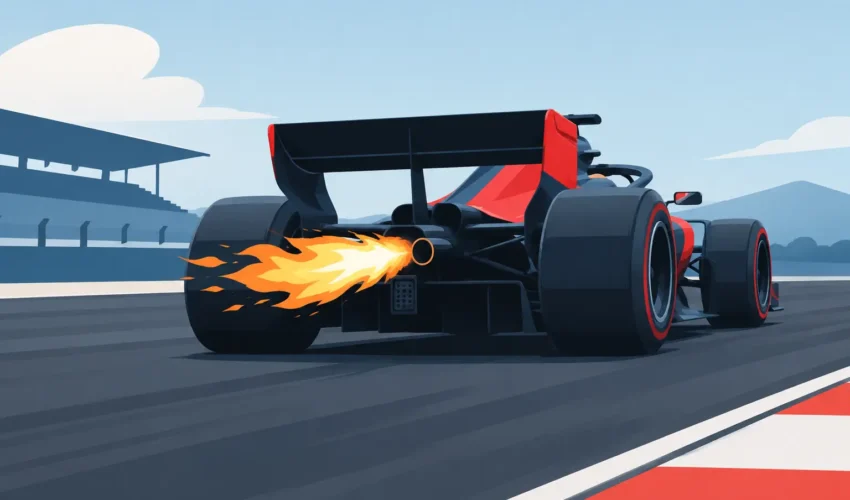

A race car fires out of a corner, the driver lifts for a split second, and the exhaust answers with a sharp crack that sounds like a gunshot. So, why do race cars backfire? Most of the time, that explosive noise is unburned fuel igniting in the hot exhaust system, not an engine randomly falling apart. In racing, the same tuning choices that make serious power can also create the pops, bangs, and occasional fireballs fans wait for.
That said, not every loud exhaust report means the same thing. A controlled burst on deceleration can be normal for a purpose-built competition car. Repeated bangs, lost power, smoke, or rough running can signal a real problem. The difference matters when the car is running flat-out.
Why Do Race Cars Backfire Under Hard Driving?
The word “backfire” gets used for nearly every explosion heard from a tailpipe, but racers and mechanics often separate two events. A true backfire happens when combustion travels backward through the intake. That can create a bang near the throttle body, intake manifold, or carburetor. It is usually a warning sign.
What spectators hear most often is actually afterfire. This occurs when fuel and oxygen make it into the exhaust, then ignite because the exhaust manifold, turbocharger housing, or catalytic system is extremely hot. The sound exits through the pipes, which is why it feels like the car is firing artillery shells from the rear bumper.
At racing temperatures, exhaust components can become hot enough to ignite leftover fuel without a spark plug doing the job. Add high exhaust flow and open or lightly muffled pipes, and even a small combustion event becomes loud enough for the grandstands.
Rich fuel mixtures leave extra fuel behind
Race engines frequently run richer air-fuel mixtures than a commuter car, especially under high load. Extra fuel helps control combustion temperatures and can provide a safety margin when an engine is making huge power. Turbocharged engines, in particular, may use additional fuel to keep cylinder and exhaust temperatures under control when boost is high.
The trade-off is simple: not every drop of fuel burns completely inside the cylinder. When the driver lifts off the throttle or shifts gears, that leftover fuel can move into the exhaust. If oxygen is present and the pipes are scorching hot, it ignites with a pop or a flame.
A rich tune is not automatically bad. It may be exactly what the engine needs during a hard pass, a qualifying lap, or a long climb under boost. But too much fuel can foul plugs, waste fuel, dilute oil, and reduce power. The fastest setup is not the one that makes the biggest bang. It is the one that delivers reliable power lap after lap.
Ignition timing can create the fireworks
Ignition timing determines when the spark plug fires relative to piston movement. For normal efficiency, combustion needs to happen at the right point in the power stroke. Race teams sometimes retard timing, meaning the spark occurs later than usual, for specific performance reasons.
Late combustion can send more heat and partially burned mixture into the exhaust. That is a prime recipe for afterfire. In certain turbo applications, deliberately retarded timing is used as part of an anti-lag strategy. The ignition event and fuel delivery keep exhaust energy high while the driver is off the throttle, helping the turbo stay spinning instead of losing boost.
The result is spectacular: rapid-fire bangs, glowing turbine housings, and flames from the exhaust. The cost is equally real. Anti-lag puts intense heat and pressure through exhaust valves, manifolds, turbochargers, and turbines. It is a competition tool, not a harmless sound effect.
Turbo Anti-Lag Makes the Loudest Pops
Turbochargers need exhaust flow to spin. When a driver lifts before a corner, exhaust flow drops and turbo speed can fall with it. When the driver gets back on the throttle, there may be a delay before boost returns. That delay is turbo lag.
Anti-lag systems attack that problem by keeping energy moving through the exhaust during off-throttle moments. Depending on the system, the engine management can add fuel, alter ignition timing, control throttle position, or use bypass air. Combustion shifts toward the exhaust side of the engine, keeping the turbocharger energized.
This is why rally cars, time-attack machines, and some high-boost drag builds can sound so violent between shifts or on corner entry. The noise is evidence of a system working under extreme conditions. It is also evidence of parts being punished. Teams accept that punishment because instant boost response can be worth more than component life in a competitive setting.
Not every turbo race car uses aggressive anti-lag. Endurance racing, budget limits, rules, fuel strategy, and reliability targets all influence the calibration. A 24-hour contender needs a different answer than a sprint car chasing one perfect lap.
Gear Changes and Throttle Lifts Add Oxygen
Fuel alone does not create the pop. It needs oxygen. During a fast shift or sudden lift, airflow through the engine changes quickly. Some engines and exhaust systems can pull fresh air into the exhaust through leaks, exhaust design, or valve overlap. Valve overlap is the brief period when the intake and exhaust valves are both open.
That fresh oxygen can meet unburned fuel in a blazing-hot header. Then comes the crack.
Sequential gearboxes can make the effect more obvious. During an upshift, engine management may cut ignition or fuel for a fraction of a second to unload the transmission. If the calibration cuts spark while fuel continues briefly, unburned fuel can enter the exhaust and ignite. The event happens fast, but at racing RPM, fast is plenty.
Older carbureted race cars can also pop when the driver lifts, though the causes may be less electronically controlled. Fuel distribution, jetting, ignition settings, exhaust leaks, and aggressive camshafts all affect what happens after the throttle closes.
Open Exhausts Make Everything Sound Bigger
Race cars are loud because their exhausts are built for performance, packaging, and weight, not neighborhood manners. Many run short, low-restriction exhaust systems with minimal muffling. That lets sound pressure escape with very little filtering.
A street car might have catalytic converters, resonators, several mufflers, and long pipe runs that soften combustion pulses. A race car may have headers leading into a short exit beside the door, behind the wheel, or straight out the back. The same afterfire that would be a muted thump in a street car becomes a sharp blast in a race machine.
Flames also become more visible with short exhaust outlets. You are not necessarily seeing more fuel than would exist in a longer system. You are simply seeing the combustion before it disappears inside multiple chambers and pipes.
When Backfiring Means Something Is Wrong
A controlled pop on overrun is one thing. Constant backfiring, especially through the intake, is another. A true intake backfire can damage airboxes, sensors, intake plumbing, and in extreme carbureted setups, even ignite fuel vapor above the engine.
Problems that can cause unwanted backfiring or afterfire include an ignition misfire, incorrect timing, a failing injector, an overly rich or lean calibration, exhaust leaks, weak spark, valve timing issues, or damaged valves. A lean condition can be particularly dangerous under load because it can increase combustion temperatures and lead to detonation or engine damage.
The context tells the story. If a car pops only on deceleration and still pulls cleanly, it may be tuned that way. If it suddenly starts banging, stumbling, losing boost, or smelling heavily of raw fuel, the driver and crew need to investigate. In motorsports, a cool flame clip is never worth ignoring a warning sign.
Why Street Cars Should Not Copy the Sound
Modern performance cars can be programmed for exhaust crackles, and that has made the race-car sound part of street-car culture. But aggressive burble tunes often rely on late timing and extra fuel, which raise exhaust temperatures and can shorten the life of catalytic converters, oxygen sensors, turbo components, and exhaust valves.
A genuine race car is maintained around those stresses. It may be inspected between sessions, rebuilt on a schedule, and run with hardware chosen for a narrow mission. A daily driver has to start every morning, pass emissions requirements where applicable, and survive traffic, heat, potholes, and thousands of miles.
The best sound is one that matches the machine. A properly tuned race engine that cracks on the overrun is pure motorsport theater. A car that suddenly backfires because something is failing is a reason to get off the throttle and find the cause. Listen closely: the noise is not just spectacle. It is the exhaust telling you exactly how hard the engine is being pushed.