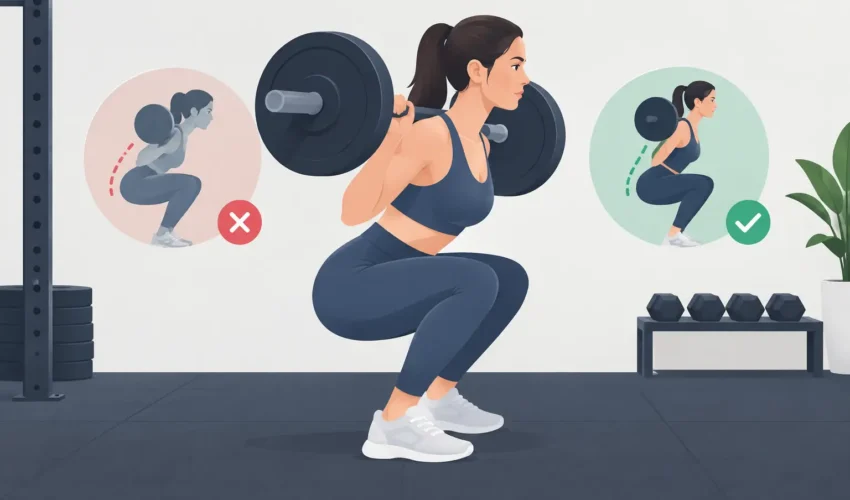

A squat can look powerful right up until the bar starts drifting forward, the knees cave, and the lifter turns a clean rep into a survival mission. Learning how to improve squat form is not about chasing a picture-perfect stance from a viral clip. It is about building positions you can repeat when the bar gets heavy, your heart rate climbs, and the set actually counts.
Improve Squat Form Before You Unrack the Bar
Your best squat starts before the first descent. If the bar is sitting awkwardly, your feet are rushed into place, or you are already loose before the walkout, every correction below becomes harder.
Set the bar at a height that lets you unrack it with a small knee bend, not a calf raise. Step under with the bar balanced over the middle of your foot. For a high-bar squat, the bar generally rests across the upper traps. For a low-bar squat, it sits slightly lower across the rear delts. Neither style is automatically superior. High-bar often allows a more upright torso and puts more demand on the quads, while low-bar can suit lifters who want to move heavier loads with more hip involvement.
Pull your upper back tight before lifting the bar out. Think of bending the bar across your shoulders while bringing your elbows down toward your ribs. This creates a stable shelf instead of letting the bar roll around on your back.
Then take two or three controlled steps back. Do not burn energy pacing around like you are entering a title fight. Place your feet around shoulder width, then adjust based on your build, mobility, and comfort. Some lifters squat best with toes nearly forward; many need their toes pointed out slightly so their knees can track naturally.
Find a stance you can own
There is no single magic foot position. A taller lifter with long femurs may need a slightly wider stance and more toe angle than a compact lifter. What matters is whether you can keep your whole foot connected to the floor while your knees track in line with your toes.
Start with a stance just outside hip width. Squat down with no weight and test whether your hips feel blocked, your heels rise, or your lower back rounds hard at the bottom. Make small changes, one at a time. Move the feet an inch wider, turn the toes out a few degrees, and test again. The goal is not to copy another athlete. The goal is a strong, repeatable groove.
How to Improve Squat Form Through Bracing and Control
A solid brace turns your torso into a stable platform for the bar. Before each rep, take a deep breath low into your stomach and sides, not just high into your chest. Tighten your midsection as if you are preparing to absorb a hard body shot. Hold that pressure as you descend, then release and reset near the top if needed.
Do not confuse bracing with sucking your stomach in. Pulling inward usually makes you less stable. Expand against your belt if you wear one, or against your own abdominal wall if you do not. A belt can give you something to brace into, but it cannot fix a loose trunk or rushed breathing.
Start the descent by letting your knees and hips bend together. The old cue that knees should never move past toes is too simple to be useful for most squats. Knees can travel forward, especially in a high-bar squat, as long as the heel stays planted and the movement stays controlled.
Keep pressure across three points of the foot: the heel, the base of the big toe, and the base of the little toe. This is often called a tripod foot. If your weight shifts hard to the toes, the bar will usually drift forward. If you rock too far back, you may lose balance or cut depth short.
Hit depth without losing position
For most lifters, a productive target is reaching at least parallel, meaning the crease of the hip is level with or slightly below the top of the knee. Competition rules may demand more depth, while certain mobility limitations, injury histories, or sport-specific programs may call for a modified range under professional guidance.
The real standard is control. Going deeper is not automatically better if your pelvis tucks under dramatically, your chest collapses, or you feel sharp pain. Build the deepest range you can own with a neutral, braced trunk and stable feet. Over time, better ankle mobility, hip control, and technique can improve that position.
At the bottom, avoid relaxing. Stay tight, keep your eyes focused ahead or slightly down, and drive up by pushing the floor away. Let the hips and shoulders rise together. If your hips shoot up first and your chest falls, the squat turns into a rough good morning with a bar on your back.
Fix the Breakdowns That Kill Strong Reps
Most form problems are not mysterious. They are usually a weak position, a load that is too ambitious, or a cue that has not been practiced enough. Watch your working sets from the side and from a front angle when possible. Slow-motion video makes bar drift and knee movement much easier to spot.
- Your heels pop up: Try lifting in flat, stable shoes, spend time on ankle mobility, and experiment with a small heel elevation. Weightlifting shoes can help some lifters reach depth with a more upright torso, but they are not mandatory for everyone.
- Your knees cave inward: A small amount of movement can happen under a hard effort, but a major collapse means you are losing foot pressure or hip control. Reduce the load, drive the knees in line with the toes, and add paused reps that force you to own the bottom position.
- Your chest drops forward: Check your brace and bar placement first. High-bar lifters may need stronger quads or better ankle range, while low-bar lifters need to accept some forward lean without letting the bar leave the midfoot.
- Your lower back rounds at the bottom: Test a slightly wider stance, a different toe angle, or a shallower depth while you improve mobility and control. Do not force your body into a range it cannot yet stabilize.
Pain is different from effort. Muscle fatigue, heavy breathing, and the normal grind of a tough rep are part of training. Sharp pain, numbness, repeated joint pain, or symptoms that worsen set to set are reasons to stop and get qualified medical or coaching input.
Use Lighter Weight to Build Heavy-Duty Positions
The fastest way to make ugly form permanent is to practice it under a load you cannot control. Strip weight from the bar long enough to feel what a balanced rep actually requires. That is not backing down. It is skill work.
Tempo squats are especially effective. Lower for three seconds, pause for one second at the bottom, then stand up with intent. The slow descent exposes balance issues immediately. If you tip forward, lose your brace, or feel your knees collapse, you have clear feedback before the bar gets heavy.
Paused squats build confidence in the hole, while goblet squats can teach newer lifters how to sit between their hips with a more upright torso. Front squats are another useful tool because they punish excessive forward lean fast. They are not replacements for back squats if your goal is a bigger back squat, but they can sharpen the positions that support it.
Use these variations with purpose. Two or three lighter technique sets before your main work can be enough. If your technique falls apart only at maximal loads, your programming may also need attention. More practice at moderate weights, better recovery, and smaller jumps in load often fix problems that endless cueing cannot.
Make Video Review Part of Your Training
The mirror is not the best squat coach. Looking sideways during a loaded rep can pull your neck and upper back out of position. Record a set instead, ideally from a side angle where you can see the bar, hips, knees, and feet.
Look for one issue at a time. Is the bar staying over the middle of the foot? Are your knees tracking with your toes? Does your torso hold its angle from the bottom through the ascent? A single correction for the next session beats trying to rebuild your entire squat in one workout.
Great squat form is not a static pose. It is a controlled, powerful pattern that holds up when the plates start clanking. Earn that pattern with patient reps, honest video review, and loads you can dominate. The bigger numbers will have a stronger platform to stand on.