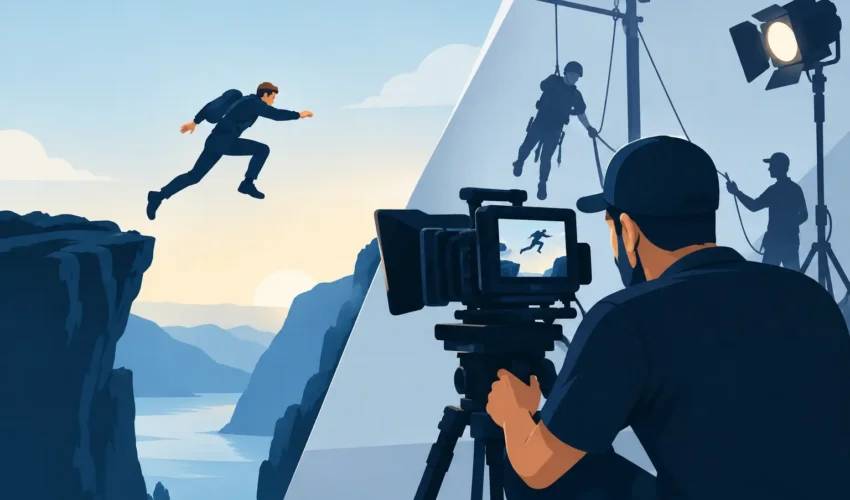

A car clears a gap, a fighter crashes through a table, a biker spins backward off a ramp, and the comments fill up fast: are stunts staged? Usually, the honest answer is yes – and that does not mean they are fake. The planning may be staged. The camera angle may be chosen. The landing may be protected. But the speed, force, timing, and risk can still be very real.
That distinction matters, especially when a 20-second clip makes a difficult move look effortless. Great stunt work is designed to create a huge visual payoff while controlling as many variables as possible. The best performers make that control nearly invisible.
Are stunts staged or actually dangerous?
Most professional stunts are staged in the literal sense: they are carefully arranged before anyone hits record. A stunt coordinator, athlete, director, safety crew, or event organizer decides where the action happens, what equipment is used, what the performer will do, and what happens if the first attempt goes wrong.
That preparation is not a cheat code. It is how people avoid turning a spectacular shot into a preventable injury.
A movie car chase might use a closed road, precision drivers, a camera vehicle, removable interior panels, a roll cage, and several rehearsals at lower speed. What viewers see is one explosive sequence. What made it possible was a long chain of decisions that started well before the engine fired.
The same principle applies to motocross, skateboarding, parkour, strongman exhibitions, martial arts demonstrations, and monster truck shows. The stunt may be planned down to the foot placement or throttle input, but the person performing it still has to execute under pressure. Planning reduces random risk. It cannot erase gravity, momentum, fatigue, weather, mechanical failure, or a split-second mistake.
Staged does not mean fake
Online arguments often treat “staged” and “fake” as the same word. They are not.
A staged stunt has a known setup and an intended result. A fake stunt uses an effect, trick, edit, or false claim to make viewers believe something happened when it did not. Plenty of videos use both real performance and movie magic. That is normal in entertainment. The problem starts when a creator sells a visual effect as an unedited real-world feat, especially if viewers may try to copy it.
A good action scene can be built from multiple real pieces. A performer jumps from a height onto an airbag. A close-up shows the reaction. A separate wide shot shows the fall. Sound design adds a heavier impact than the real landing made. The final cut feels brutal because it is designed to feel brutal.
None of that makes the performer unskilled. In many cases, it proves the opposite. A stunt performer must hit marks, protect their body, repeat the motion, and make it look uncontrolled without actually losing control.
In movies and television
Film stunts are among the most organized examples. The action is choreographed for the lens, not just for the performer. A punch that looks flush may stop short. A glass window may be breakaway material. A massive crash may involve real vehicles, but the shot can combine practical driving, rigging, visual effects, and post-production.
The trade-off is realism versus repeatability. A director wants danger on screen. The stunt team wants a sequence that can be performed safely and consistently. The smartest productions find a middle ground: enough practical action to feel physical, enough control to get everyone home.
In professional wrestling
Professional wrestling is staged in terms of storylines, match outcomes, and many sequences. It is not staged in the sense that the ring suddenly stops being hard or that a bad landing does not hurt.
Wrestlers train to cooperate, communicate, fall safely, and make contact look more violent than it is. Even with that training, injuries happen. A body slam, a leap from the ropes, or a table spot demands strength, timing, trust, and pain tolerance. The performance is planned, but the athletic strain is real.
In action sports
Action-sports clips can be harder to label because they range from fully planned productions to raw competition attempts. A downhill rider may inspect a line, practice the jump, and place cameras at key points. That is staging the shoot. The run itself can still be one hundred percent real.
Competition is different again. The course is set, the rules are known, and the broadcast is produced, but athletes do not get to control the outcome. A snowboarder can plan a trick for months and still miss the grab, over-rotate, or lose an edge when it counts.
How to tell when a viral stunt is produced
A polished clip is not automatically deceptive. Still, a few clues can help you watch with sharper eyes.
Look at the environment first. Closed streets, clean landing zones, visible spotters, crash pads just outside frame, matching uniforms, and multiple camera angles usually signal a planned production. So does a perfect camera position for a supposedly spontaneous moment. That is often a sign that a team knew what was about to happen.
Then look at the edit. Fast cuts can hide setup changes, failed attempts, cables, padding, and the real impact. Slow motion can make a modest drop look massive. Tight framing can remove the ramp that made a jump possible. Audio can be completely rebuilt after the fact.
That is not a reason to dismiss the video. It is a reason to understand the craft. A skilled editor can turn a strong stunt into a jaw-dropping one. A dishonest editor can turn a harmless setup into a dangerous-looking lie.
Context is the biggest tell. Credible creators often show training, equipment, behind-the-scenes footage, safety teams, or repeat angles. Accounts that only post miraculous one-take clips with no context deserve more skepticism. If the stunt seems to break basic physics, it probably has help from perspective, editing, or a setup the video does not show.
The hidden work behind a big stunt
The most impressive part of stunt content is often what never makes the final clip. Performers build capacity before they chase spectacle. A freerunner drills landing mechanics. A driver learns vehicle balance and emergency responses. A martial artist practices distance and control. A strength athlete develops tendons, joints, grip, and technique over years.
Professionals also manage risk in layers. They check gear, set boundaries, rehearse movement, establish signals, plan exits, and know when to stop. A helmet, harness, mat, roll cage, or spotter may look less exciting than the final move, but those are the details that separate calculated action from reckless content.
This is where viral imitation goes wrong. Viewers see the payoff but not the repetitions, coaching, location permits, medical plan, or failed takes. Trying to recreate a stunt in a parking lot, gym, rooftop, or public road strips away the exact safeguards that made the original possible.
Why staged stunts can be more impressive
There is a strange idea that the less planned a stunt is, the more it deserves respect. In reality, uncontrolled danger is rarely the highest form of skill. Precision is.
Watching a stunt team place a car within inches of a camera, a motocross rider hit a narrow takeoff at speed, or a performer sell a fight sequence without hurting their partner shows a different level of mastery. These people are not just brave. They understand their bodies, their machines, their environment, and the limits of each.
For viewers, the sweet spot is enjoying the spectacle without confusing it for an invitation. Watch the impossible jump, the wild crash, the knockout-level choreography, and the perfectly timed prank with curiosity. Then appreciate the planning that kept a huge moment from becoming a terrible one.
The next time a clip looks too clean, do not ask only whether it is real. Ask what it took to make it look that real. That answer is usually where the real skill lives.