
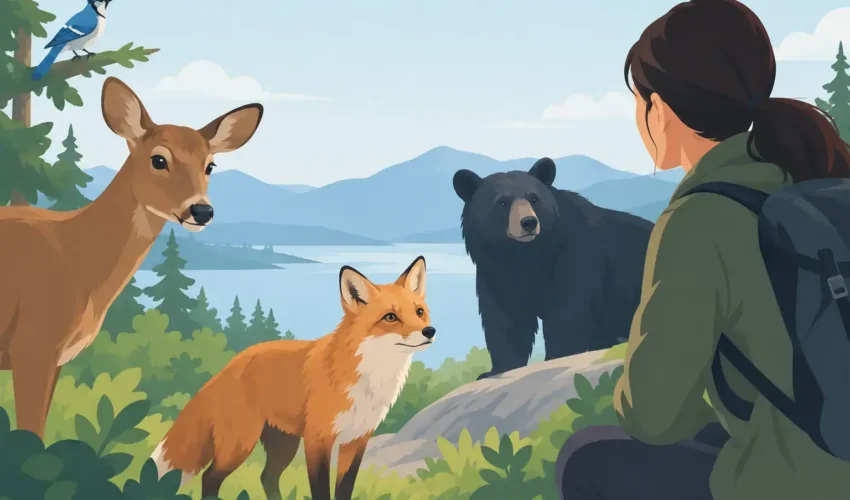

A crow spots the person who once chased it from a parking lot. A deer pauses at the edge of a familiar trail. A bear changes course after catching a human scent on the wind. Can wildlife recognize humans? Often, yes – but not in the simple, movie-style way people imagine.
Wild animals do not need to know your name, understand your intentions, or see you as an individual friend or enemy to react differently around you. Many can learn the sights, sounds, smells, movement patterns, and routines associated with particular people. In the wild, that recognition is usually about one thing: survival.
Can Wildlife Recognize Humans as Individuals?
Some species appear capable of distinguishing individual humans, especially animals with strong vision, advanced social intelligence, or frequent exposure to people. Crows and other members of the corvid family are famous examples. Research has shown that crows can remember threatening human faces for years and may warn other crows about a person they associate with danger.
Primates, elephants, dolphins, and some parrots also have the brainpower and social awareness to make fine distinctions between people. Domestic animals do this constantly, but wildlife can do it too when encounters are repeated and meaningful. A bird feeder visitor may learn who reliably fills the feeder. A fox near a campground may learn which person leaves food unsecured. A coastal animal may recognize the sound of a familiar boat engine.
That does not mean every animal is studying faces. For many species, scent does the heavy lifting. A deer, wolf, bear, or coyote may identify a human presence long before a person comes into view. Wind direction, sweat, detergent, smoke, vehicle exhaust, and a dog’s scent can all become part of the signal.
Recognition also depends on context. An animal that ignores a jogger on a busy urban path may become alarmed by the same person approaching directly through brush. It is not necessarily being inconsistent. It is reading the situation.
What Wildlife Actually Uses to Identify Us
Animals live in a sensory world that does not always match ours. Humans tend to think recognition begins with a face. For wildlife, a face might be just one clue in a much bigger picture.
Faces, posture, and movement
Birds with sharp vision can be especially tuned to visual details. They may notice your hat, jacket color, body shape, gait, or whether you are carrying a camera, a fishing rod, or something more threatening. Large mammals can also learn silhouettes and movement patterns, particularly around roads, farms, parks, and developed areas.
The way you move matters. A calm hiker walking past at a predictable pace sends a different message than someone stopping, crouching, staring, or moving straight toward an animal. Direct approach is a pressure signal in the animal world. What looks like curiosity to a person can feel like a challenge or a trap to wildlife.
Voice and noise
Some animals learn voices, while others respond more to volume, rhythm, and tone. A ranch-adjacent elk herd may grow used to machinery and regular human conversation but react sharply to an unfamiliar engine or sudden shouting. Urban birds often sort the nonstop background noise from sounds that deserve attention.
This is why a viral clip can be misleading. An animal that appears relaxed near a loud crowd may simply be habituated to that setting, not comfortable with all people everywhere.
Scent and routine
For scent-driven mammals, smell can be the first alert and the final verdict. Bears have an extraordinary sense of smell. Deer, coyotes, raccoons, and many other species use scent to map risk across an area. They can also learn routines: the time a trash bin goes out, the route a dog walker takes, or the hour anglers arrive at a shoreline.
Routine recognition can look impressive, but it has a downside. When animals connect humans with easy calories, the result can be dangerous for both sides. Food-conditioned wildlife may approach people more often, raid campsites, enter neighborhoods, or become aggressive when the food does not appear.
Recognition Is Not Trust
This is the part that gets lost when a close wildlife encounter looks incredible on video. An animal can recognize you and still be stressed by you. It can recognize you and choose to tolerate you because it has nowhere else to go. It can recognize you and be waiting for food.
A deer that stands still for photos is not automatically tame. A raccoon that walks toward a porch is not asking to be fed. A bear that seems uninterested may still react instantly if surprised, crowded, injured, protecting cubs, or defending food.
Habituation and food conditioning are not the same thing. Habituation means an animal has become less reactive to a repeated, non-threatening presence. Food conditioning means it has learned that people provide meals. The first can happen in cities and parks. The second can escalate quickly and often ends badly for the animal.
That distinction matters for anyone filming outdoors. The best wildlife footage often comes from patience, distance, and understanding the animal’s normal behavior – not from pushing closer for a dramatic reaction.
Why Some Animals Seem to Know the “Good” Humans
People sometimes describe a backyard fox, beach bird, or neighborhood deer as if it can sense who has a good heart. The real explanation is usually more practical and more fascinating.
Wildlife learns patterns. One person moves slowly and gives space. Another throws rocks, lets a dog chase, or leaves food behind. One vehicle regularly stops at a trailhead but never approaches. Another pulls over, doors slam, and people walk directly into cover. Animals that survive by noticing these differences can gain an edge.
They may also learn from one another. Social species pass along danger information through alarm calls, behavior, and group habits. If crows repeatedly mob someone near a nest, younger birds may learn that the person is a threat without having a direct bad encounter themselves. In a herd or flock, one animal’s alarm can reshape the reaction of many.
But avoid assigning a human moral story to every response. An animal that approaches may be bold, hungry, accustomed to people, sick, or defending a space. An animal that flees may be healthy and acting exactly as it should.
How to Watch Wildlife Without Becoming Part of the Problem
Spectacular animal encounters are worth watching, filming, and sharing. The rule is simple: let the animal control the distance. If it changes direction, freezes, vocalizes, raises fur or feathers, repeatedly looks at you, or leaves the area, you are too close.
Keep your movements predictable and your voice low. Do not call, whistle, clap, bait, feed, or play animal sounds to force a reaction. Never block an animal’s path to water, cover, young, or an escape route. If you are filming from a vehicle, stay inside unless the location specifically allows otherwise.
A longer lens, binoculars, and patience beat a close approach every time. They also produce better footage because the animal is more likely to show natural behavior. The goal is not to prove that wildlife will tolerate a human. The goal is to see what it does when it can stay wild.
The Real Answer Is Written in Behavior
Wildlife recognition is real, but it is rarely personal in the way humans mean it. Animals may remember a face, a scent, a voice, a truck, a trail routine, or a past threat. They are constantly collecting information about what is safe, what is risky, and what is worth avoiding.
That is what makes a distant encounter so powerful. When a wild animal notices you, then calmly returns to its own world, you have not earned its friendship. You have earned a glimpse – and the smartest move is to leave that wildness intact.