
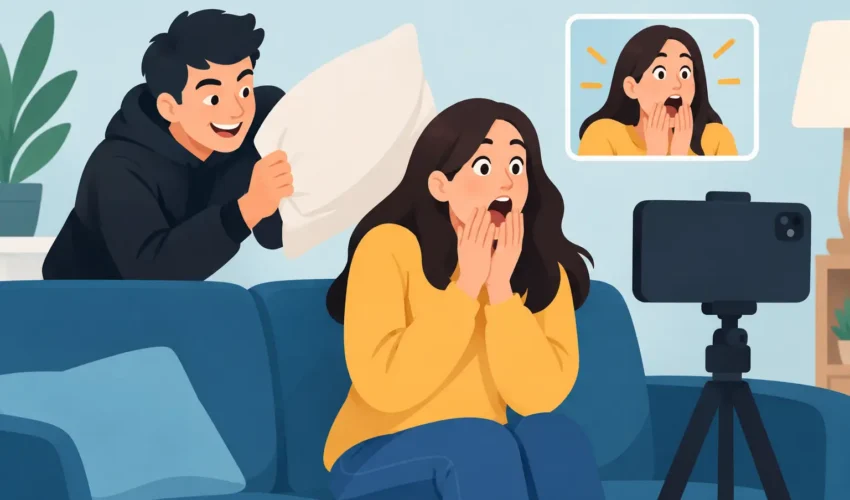

A stranger freezes when a fake spider drops onto the sidewalk. A gym buddy turns around to find his lifting belt replaced with a pool noodle. For a few seconds, nobody knows whether to laugh, run, or start filming. That split-second uncertainty is why prank reaction videos remain one of the internet’s most reliable forms of entertainment.
The best clips do more than catch somebody off guard. They build a tiny story at full speed: setup, surprise, reaction, release. When the reaction is real and the joke stays harmless, viewers get the rush without being the person standing in the blast zone. When it turns cruel, dangerous, or obviously staged, that same rush disappears fast.
Why prank reaction videos pull viewers in
A good prank has stakes, even when they are small. Will the person scream? Will they figure it out immediately? Will the prankster keep a straight face? Viewers watch because they want the answer, and a strong reaction delivers it in seconds.
The format also works across almost every interest category. A prank at a car meet can involve a ridiculous fake engine sound. A martial arts gym clip might hinge on a student being challenged by someone who looks completely unassuming. In a fitness setting, the joke may be a harmless piece of equipment confusion that ends with the whole room laughing. The setting brings in the niche audience. The reaction makes the clip shareable outside that niche.
There is another reason these videos travel: reactions are easy to read. A double take, a stunned silence, an uncontrollable laugh, or a friend immediately calling out the prankster needs almost no explanation. That matters in a fast-scrolling feed where a viewer decides in one or two seconds whether a video deserves their attention.
The formula behind a replay-worthy reaction
Prank reaction videos look spontaneous, but the clips that hold attention usually have a clear structure. The camera establishes where the action is happening, the audience notices something slightly unusual, then the reveal lands before patience runs out. The payoff has to be visible. If viewers cannot tell what changed or why someone reacted, the joke loses force.
The setup should be quick, not hidden
The strongest setups give the viewer just enough information to get ahead of the target. Maybe the audience sees a remote-controlled object tucked behind a parked truck, or notices that a friend has been handed a suspiciously oversized package. That advantage creates anticipation.
Overexplaining kills the momentum. A long intro, five camera angles, and a minute of whispered planning can make a simple prank feel like work. Start close to the action. Let the situation speak for itself.
The reaction is the main event
A creative idea is only half the clip. The reaction is what people remember. Genuine surprise has messy timing: someone talks over the reveal, steps backward, laughs before they understand what happened, or looks around for an explanation. Those unscripted details make a video feel alive.
That is why forced reactions are a weak trade. Staging a prank can help with safety and filming permissions, but performers need room to respond naturally. If every face is perfectly framed and every line sounds rehearsed, viewers will spot the setup and move on.
The release matters too
A prank should not leave the target confused, embarrassed, or frightened for longer than necessary. The reveal needs to be clear, followed by a check-in, a laugh, or an apology if the surprise landed harder than expected. A clip that ends on everybody smiling has more staying power than one that ends in an argument.
Funny has limits, and viewers know it
The line between bold comedy and bad judgment is not complicated. If a prank risks injury, triggers panic, destroys property, targets a stranger who cannot easily leave, or humiliates somebody for an audience, it is not worth the view count.
Public pranks need extra care. People may not know they are being filmed, may be dealing with stress outside the frame, or may interpret a fake threat as a real one. Anything involving fake weapons, fake emergencies, aggressive confrontation, reckless driving, physical contact, or interference with workers can create consequences far beyond an awkward viral moment.
The same goes for gyms, garages, events, and other enthusiast spaces. These places have their own rhythms and risks. Distracting someone under a heavy barbell, touching a vehicle without permission, startling a rider near traffic, or interrupting a coach during training is not playful. It is a shortcut to injury, conflict, or getting thrown out.
Consent can be handled without draining the humor. Friends who understand the channel’s style can agree to participate. Filmmakers can reveal the prank immediately and ask whether the footage can be used. If someone says no, that answer is final. A great clip is never worth turning a stranger into unwilling content.
Making prank content people want to share
For creators, the goal is not to make the target look foolish. It is to create a moment the whole group can enjoy. The best ideas usually come from everyday situations that can be exaggerated safely: a fake parking ticket on a friend’s car, an absurdly dramatic announcement at a barbecue, a harmless switcheroo in a garage, or a costume reveal timed for maximum confusion.
Keep the camera work simple. One angle that shows the setup and the person reacting is better than a hyperactive edit that hides the joke. Capture clean audio when possible, because a sharp gasp, a confused question, or the moment everyone starts laughing can be the difference between a decent clip and a repeat watch.
Editing should protect the pace. Cut dead time before the reveal, but do not cut away from the reaction too early. Let viewers see the target realize what happened. Then end while the energy is still high. A 25-second clip with a clear payoff can beat a three-minute video that takes too long to get there.
Titles matter, but they should not promise chaos the footage does not deliver. A direct title such as “He Thought the Car Started Itself” gives viewers a reason to click without inventing danger. The thumbnail should show the reaction or the strange object at the center of the prank, not a random freeze-frame designed only to confuse people.
For creators sharing through platforms such as VIDS24, category context can help the right audience find the joke. A garage prank belongs with cars and motorsports. A lifting-room surprise belongs with fitness. Put the setting front and center, then let the reaction do the heavy lifting.
How to spot the clips worth your time
As a viewer, trust your first read of the mood. Is everyone laughing by the end? Does the person targeted have room to say no? Is the prank built around surprise rather than fear or humiliation? Those signals tell you far more than a massive view count.
The most satisfying reaction videos leave you with a story you want to send to a friend: the guy who could not believe the engine noise, the sister who immediately recognized the costume, the entire gym losing it after a harmless switch. They create a burst of shared disbelief, then get out of the way.
A prank is at its best when the reveal turns tension into laughter and everybody gets to keep their dignity. Make that the standard, and the reaction will be worth watching twice.