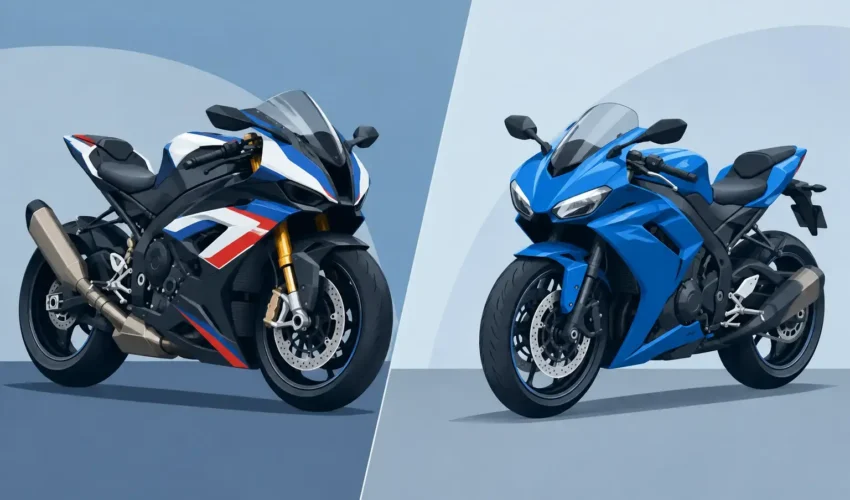

A 1,000cc sportbike firing out of a corner can look like a superbike. A superbike idling in a paddock can look like a sportbike. That is why the superbike vs sportbike debate gets messy fast: the labels overlap, marketing uses them loosely, and the rider’s intent changes the answer.
The cleanest way to see it is this: sportbike is the broad family. Superbike usually means the sharpest, most powerful production-based machine in that family, especially when racing is part of the conversation. One is a category. The other is a top-tier expression of it.
Superbike vs Sportbike: The Basic Difference
A sportbike is a street motorcycle designed around performance. It typically has a forward riding position, responsive handling, strong brakes, aerodynamic bodywork, and an engine tuned to feel alive when the revs climb. Sportbikes range from approachable lightweight machines to serious 1,000cc weapons.
A superbike is usually a high-performance literbike built close enough to a production motorcycle to qualify for superbike racing regulations. Think 1,000cc inline-fours and V4s making huge horsepower, with advanced electronics, premium suspension, aggressive geometry, and track-focused bodywork. In casual rider talk, people also use “superbike” for any exotic or brutally fast sport machine. That usage is understandable, but it is less precise.
Not every sportbike is a superbike. A Kawasaki Ninja 400, Yamaha R7, Suzuki GSX-8R, or Honda CBR600RR fits under the sportbike umbrella without being a superbike. A Ducati Panigale V4, BMW S 1000 RR, Yamaha YZF-R1, or Honda CBR1000RR-R sits much closer to the superbike end of the spectrum.
Sportbike Is the Bigger Category
Sportbikes are built in several performance bands, and those bands change how the motorcycle behaves on a real road or a track day.
Lightweight sportbikes usually use engines from roughly 300cc to 500cc. Their power is manageable, their weight is low, and their limits are easier to explore without instantly reaching outrageous speeds. They reward momentum, clean corner entries, and riders who want to develop skill instead of merely hanging on.
Middleweight sportbikes traditionally include 600cc and 750cc four-cylinder machines, though modern twins and triples have blurred the old displacement rules. These bikes often deliver the classic high-revving sportbike experience. They can be demanding, but they are generally less violent than a modern literbike when the throttle opens.
Then come liter-class sportbikes. This is where the sportbike label begins to overlap heavily with superbike. A 1,000cc sportbike can make well over 180 horsepower in stock form, and some machines reach far beyond that. The difference between “literbike” and “superbike” may come down to racing context, equipment level, or simply what the manufacturer and owner call it.
What Makes a Superbike Feel Different
The headline number is horsepower, but raw output is not the whole story. A true superbike is designed to attack a lap, not just impress at a stoplight.
Its chassis is stiff and purposeful. Its suspension is often highly adjustable, allowing a skilled rider or technician to tune compression, rebound, preload, ride height, and geometry for a specific track. Its brakes are built to take repeated high-speed punishment. Its tires are wide, sticky, and expensive for a reason.
Electronics are another major separator. Modern superbikes may have multiple power modes, cornering ABS, lean-sensitive traction control, wheelie control, slide control, launch control, quickshifters, auto-blippers, engine-brake management, and data logging. These systems do not turn a novice into a racer. They give an experienced rider more control over a machine that can overwhelm the rear tire, lift the front wheel, or gain speed at a shocking rate.
That is the magic and the danger. A superbike can feel calm at low throttle, then turn savage as revs and throttle position build. On a racetrack, that intensity is thrilling. On a crowded public road, it can be more capability than the environment can safely use.
Racing Explains the Name
“Superbike” has deep roots in production-based racing. In World Superbike and national superbike championships, the motorcycles begin as street-legal production models, then receive race modifications. The rulebook sets limits on engine configuration, displacement, components, and modifications so the machines remain connected to bikes people can actually buy.
That connection is a huge part of the appeal. Fans watch a superbike launch past 180 mph, trail-brake into a corner, and fight for grip at impossible lean angles, then recognize the headlights and silhouette from the dealership floor.
A race superbike is not identical to the showroom version. Race exhausts, suspension internals, electronics calibration, tires, braking components, and stripped weight transform the machine. Still, the production motorcycle is the foundation. That is why a high-spec literbike earns so much respect: it is close enough to racing hardware to carry real track credibility.
The Street Reality: Faster Is Not Always Better
For many riders, a middleweight sportbike is the more exciting motorcycle on public roads. That may sound backwards until you look at where the fun happens.
A 600cc-class machine lets riders use more throttle more often. Its power arrives higher in the rev range, so it asks for commitment and technique. On a technical road, that can create a more involving ride than a literbike that reaches illegal speeds before the next braking zone appears.
Superbikes also bring real ownership costs. Insurance can be steep. Premium tires wear quickly. A drop can destroy expensive fairings, winglets, mirrors, levers, and sensors. Maintenance may be more specialized, and a track day can expose how quickly consumables disappear when a 1,000cc motorcycle is ridden hard.
Comfort matters too. Most sportbikes are not built for long-distance touring, but superbikes tend to be especially uncompromising. Their clip-ons are low, rearsets are high, heat management can be intense, and their steering lock may feel laughably limited during a parking-lot turn. The price of race-bike body language is paid at every gas station and red light.
Which One Fits Your Riding?
Choose by where and how you ride, not by the badge that looks best in a video clip.
A newer rider, or someone returning after years away, will usually build confidence faster on a lightweight or middleweight sportbike. These motorcycles still demand respect, but they communicate more clearly near their limits. You can work on braking, vision, body position, throttle control, and corner exits without a tiny wrist movement turning the next straight into a missile launch.
A superbike makes more sense for experienced riders who regularly attend track days, understand suspension setup, and want a machine with a very high ceiling. It also makes sense for the rider who simply wants the engineering, sound, and visual drama of a flagship machine, as long as they are honest about the responsibility that comes with it.
There is no shame in choosing the smaller bike. Skilled riders on lightweight machines regularly embarrass overconfident literbike owners at the track because corner speed, braking discipline, and smooth inputs matter more than a spec-sheet war.
Don’t Confuse the Look With the Job
Fairings, clip-ons, and a raised tail section do not automatically make a motorcycle a superbike. Plenty of sporty-looking bikes are designed for daily riding, lower insurance costs, and accessible power. That is not a compromise in the negative sense. It is often smart engineering for real riders.
Likewise, a superbike is not automatically the best track bike for every person. A high-end 1,000cc machine can be physically tiring and mentally demanding. Riders may spend an entire session managing acceleration instead of improving their line. A smaller sportbike can produce more laps, more learning, and more grins per gallon.
For viewers, the distinction adds another layer to the spectacle. A superbike video is often about savage acceleration, onboard race footage, massive lean angles, and the sound of a high-strung engine at full attack. A sportbike clip can be just as compelling when it captures a clean canyon run, a rider’s first track day, or a lightweight machine being pushed with precision.
The best choice is the motorcycle that makes you want to ride more, train harder, and leave enough margin to ride again tomorrow. Whether it wears a superbike badge or a sportbike label, respect the power, wear the gear, and save the full-throttle hero moments for a place built to handle them.