
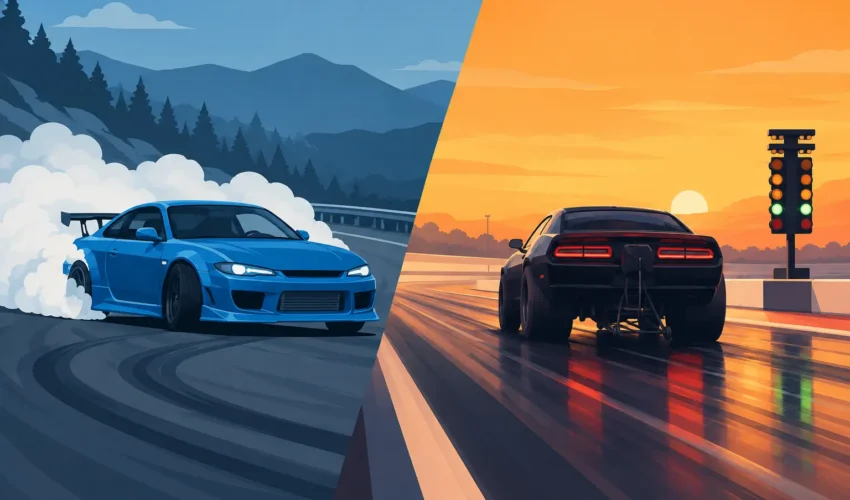

A drift car enters the corner sideways with tire smoke pouring off the rear wheels. A drag car sits staged, engine loaded, waiting for a light that can turn a quarter-mile into a few explosive seconds. Drift racing versus drag racing is not just a question of which one is faster. It is a choice between two completely different forms of automotive pressure, skill, and spectacle.
Both scenes reward serious machine setup and fearless drivers. Both create the kind of clips that make car fans replay launches, saves, close tandems, and near-perfect runs. But the way they ask a driver to perform could not be more different.
Drift Racing Versus Drag Racing: The Core Difference
Drag racing is a straight-line contest against the clock and the car in the other lane. The mission is brutally simple: leave hard, keep the car planted, shift cleanly, and reach the finish first. At the top levels, races can be decided by thousandths of a second. A tiny loss of traction, a late reaction, or a missed gear can destroy an otherwise powerful pass.
Drifting is controlled oversteer judged through speed, angle, line, commitment, and style. In competition, drivers often run solo qualifying laps before facing an opponent in tandem battles. The lead driver is expected to attack the prescribed course, while the chase driver must stay close, mirror the angle, and apply pressure without making contact.
That distinction matters. A drag racer tries to eliminate wheelspin. A drift driver deliberately creates it, then manages it at speed. One car wants maximum forward bite. The other needs enough rear-wheel freedom to slide while retaining control and momentum.
The Driving Skills Behind the Spectacle
A strong drag launch is far more technical than simply flooring the throttle. Drivers and crews balance tire temperature, suspension setup, boost, gearing, track surface, and power delivery. In a manual car, clutch control and shift timing are critical. In high-horsepower automatic builds, the driver still has to manage staging, reaction time, and a vehicle that may be fighting to move in every direction except straight ahead.
The best drag racers look calm because every part of the run is rehearsed. They read the track, understand the car’s behavior, and make decisions in a few seconds at serious speed. For viewers, that is part of the appeal: a machine that sounds angry, hooks hard, and covers ground with ridiculous force.
Drifting asks for a more visible kind of control. Drivers use throttle, steering, brakes, clutch kicks, weight transfer, and sometimes a hydraulic handbrake to initiate and hold a slide. Then they must link one corner to the next without losing the line or slowing down too much.
In tandem drifting, the pressure rises fast. The chase driver has to stay close enough to look dangerous while leaving enough margin to avoid a crash. The lead driver has to maintain a convincing, fast run while another car fills the mirrors. It is part motorsport, part choreography, and when it is good, it is impossible to ignore.
What the Cars Need to Do
Drag cars are built around acceleration. Power is essential, but putting that power down is the real fight. Dedicated drag builds may use slicks, wheelie bars, parachutes, strengthened rear ends, racing transmissions, and suspension geometry designed specifically for hard launches. Even street-oriented drag cars often prioritize torque, traction, cooling, and durability over cornering finesse.
A drift car needs a different balance. Rear-wheel drive is the traditional choice because it makes sustained oversteer easier to control. Drivers typically want predictable power, a strong cooling system, a durable drivetrain, steering angle, and suspension that helps the car transition cleanly from one slide to another. Big horsepower can make drifting more dramatic, but an overly aggressive powerband can make a car harder to place precisely.
That is why a modestly powered, well-sorted drift car can be more entertaining than a high-dollar build that constantly spins. The same logic applies at the drag strip. A wildly powerful car that cannot hook is often slower than a less powerful car with the right setup.
Cost, Wear, and the Reality Beyond the Highlight Reel
Neither discipline is cheap once the pace gets serious. Tires alone can eat a budget fast. Drifting burns rear tires by design, and a full day of hard laps or tandem practice can turn fresh rubber into smoke. The repeated abuse also reaches clutches, axles, differentials, engines, and body panels. Contact happens, especially when drivers are pushing door-to-door.
Drag racing can be equally unforgiving, particularly as horsepower rises. A strong launch shocks the drivetrain, while repeated full-throttle passes punish engines, transmissions, and tires. Competitive racers also spend heavily on safety equipment, data logging, track fees, transport, and maintenance between events.
For newcomers, local events are the smarter entry point. A street-legal car, proper helmet, honest mechanical inspection, and a willingness to learn can go a long way. Do not assume viral clips show the full bill. The most impressive builds are usually backed by years of wrenching, testing, broken parts, and disciplined safety practices.
Which Is Better for Fans?
It depends on what makes you hit replay.
Drag racing delivers immediate payoff. The staging sequence builds tension, the light drops, and the result arrives almost instantly. It is perfect for fans who love horsepower figures, turbo sounds, superchargers, launch control, and the raw violence of a car trying to outrun another car in a straight line. A clean pass from a sleeper build can be just as satisfying as a purpose-built monster lifting the front wheels.
Drifting gives viewers more time to watch the driver work. You can see the corrections, the smoke, the transitions, and the inches separating two cars in tandem. It is easier for a casual viewer to recognize the drama because the action is happening in plain sight. The car is sideways, the wall is close, and the chase driver is refusing to back off.
That visual language makes drifting especially strong on video. A single corner can hold a huge save, a near-miss, or a perfect door-to-door battle. Drag racing creates its own unforgettable footage, especially with onboard cameras, slow-motion launches, and night passes under track lights. VIDS24 viewers who want maximum automotive spectacle will find plenty to enjoy in both.
The Safety Line Matters
The excitement is real, but so is the risk. Drifting on public roads, street racing, and unsanctioned takeovers put drivers, spectators, and bystanders in danger. They also give legitimate motorsport communities a problem they did not create.
Tracks, sanctioned drift events, and properly managed drag strips exist for a reason. They provide barriers, emergency support, safety rules, inspections, controlled surfaces, and room to learn. A helmet is not a magic shield, and horsepower is not a substitute for instruction. Build skill before chasing the clip.
Choose the Rush That Fits You
Pick drag racing if you are obsessed with launches, acceleration, tuning data, and the challenge of making huge power stick. Pick drifting if you love car control, corner speed, smoke, style, and the constant conversation between driver, throttle, and chassis.
The best way to settle the debate is not to argue in a comment section. Watch a close tandem battle, then watch a clean heads-up pass where two cars leave together and one wins by inches. The rush comes from different places, and that is exactly why both belong in the motorsports conversation.