
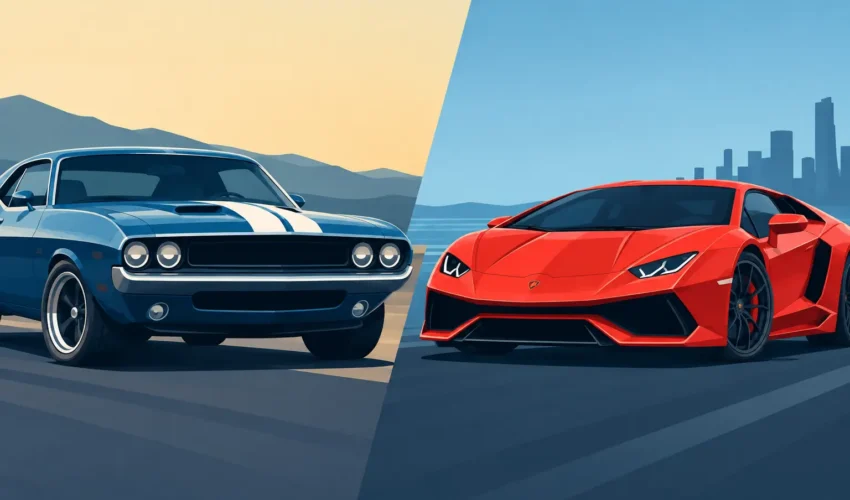

The argument over muscle cars versus supercars usually starts with horsepower and ends with someone playing an exhaust clip at full volume. That is understandable. Few machines deliver visual drama, mechanical noise, and instant bragging rights like a wide-body American V8 or a low-slung exotic with doors that rise skyward.
But these cars are built to create different kinds of adrenaline. One is about big-displacement attitude, straight-line violence, and a presence that fills a parking lot. The other is about precision, exotic engineering, and the surreal feeling of driving something that looks built for a closed course. Neither automatically wins. The better question is: what kind of rush do you want?
Muscle Cars Versus Supercars: The Core Difference
A muscle car is traditionally a relatively attainable American coupe with a large engine, rear-wheel drive, and a mission centered on acceleration. The classic formula was simple: put the biggest V8 possible into a midsize body, keep the attitude aggressive, and let the tires sort out the rest. Modern examples have become far more sophisticated, but that blunt-force character still matters.
A supercar is designed as an all-around performance machine with a stronger focus on handling, braking, aerodynamics, lightweight materials, and high-speed stability. It may use a naturally aspirated V10 or V12, a turbocharged V8, a hybrid system, or a combination of all three. The engine is often mounted behind the driver, the seating position is low, and every air intake looks like it has a job to do.
The line can blur. A Chevrolet Corvette Z06 can run with serious exotic hardware. A Ford Mustang GTD is engineered with track ambition far beyond the old muscle-car formula. At the same time, some so-called supercars are mostly bought for nightlife, garage photos, and weekend coffee runs. Labels are useful, but the driving experience tells the real story.
Straight-Line Speed: Big Torque Meets Launch Control
Muscle cars built their reputation one quarter-mile at a time. A supercharged Dodge Challenger Hellcat, Ford Mustang Dark Horse, or Chevrolet Camaro ZL1 makes the kind of power that turns a highway merge into an event. The point is not subtlety. Hit the throttle and feel the rear end squat, the exhaust deepen, and the scenery arrive faster than expected.
Supercars are no longer easy targets at the drag strip, though. All-wheel-drive systems, dual-clutch transmissions, sticky factory tires, and advanced launch control let many exotics fire off brutally quick runs with repeatable consistency. A modern Ferrari, Lamborghini, McLaren, or Porsche can use every fraction of available grip while the driver keeps both hands on the wheel.
On a prepared strip, the result depends on the cars in question. A powerful muscle car can embarrass machines that cost several times more. In a rolling race, its torque and high-output V8 may be even more dangerous. But when traction is limited or launches need to be perfect every time, a properly engineered supercar often turns its technology advantage into a gap.
The muscle-car win is emotional as much as numerical. A supercar may post the quicker time, but few things look as wild on video as a blown V8 fighting for grip with the front wheels light and the rear tires hazing.
Corners, Brakes, and Track Confidence
This is where the supercar earns its price tag. Supercars are usually designed around balance. Their low center of gravity, advanced suspension geometry, powerful brakes, aero elements, and often mid-engine weight distribution give them confidence through high-speed turns. They are not merely fast between corners. They are designed to attack the corners.
A modern performance muscle car is far better than the stereotype suggests. Magnetic dampers, wider tires, electronic limited-slip differentials, track-focused cooling, and selectable drive modes have transformed cars like the Camaro ZL1 1LE and Mustang GTD into serious circuit weapons. Put a skilled driver behind the wheel, and the old “only fast in a straight line” joke gets old quickly.
Still, physics has a sense of humor. A heavier, front-engine coupe carrying a large V8 usually has more mass to manage than a purpose-built exotic. On a technical road course with repeated braking zones and fast direction changes, the supercar’s chassis tends to feel more composed. It asks for cleaner inputs and rewards them with speed that feels almost unreal.
That does not make the muscle car less entertaining. In fact, its movement can be part of the appeal. A little tire slip, a steering correction, and a loud downshift can make the driver feel involved in a way that a perfectly planted all-wheel-drive machine sometimes does not.
Sound and Presence: The Part No Spec Sheet Captures
A muscle car has a soundtrack that does not need an introduction. The idle has a pulse. The exhaust note is deep, rough, and physical. Even people who could not name the engine know something serious is coming when a cammed V8 rolls into view.
Supercars make a different kind of noise. A high-revving V10 has a sharp, metallic howl. A V12 can sound like an orchestra having an argument at 8,000 rpm. Turbocharged exotics bring wastegate chatter, intake noise, and explosive shifts. The experience is less about bass and more about theater.
Then there is the visual factor. Muscle cars look powerful because they are familiar shapes turned up to maximum volume: hood scoops, wide fenders, spoilers, and tires that look ready for trouble. Supercars look impossible because they sit low, wide, and dramatic from every angle. Pull up in a bright orange Lamborghini, and cameras appear. Pull up in a blacked-out Hellcat, and people expect burnouts.
For car-video fans, this distinction matters. A supercar clip delivers instant luxury and spectacle. A muscle-car clip often delivers personality: cold starts, engine builds, track-night launches, dyno pulls, and the occasional moment when too much throttle makes the story interesting.
The Real Cost of Ownership
Purchase price is the obvious divide. A new or used muscle car can put huge horsepower within reach of people who cannot justify exotic-car money. Parts availability is generally better, mechanics are easier to find, and the aftermarket is massive. Want more power, louder exhaust, drag radials, or a suspension upgrade? There is a proven path for that.
Supercars demand a different financial mindset. Insurance can be steep, maintenance can be specialized, and a minor repair can become a serious invoice. Tires, carbon-ceramic brakes, bodywork, fluids, and service schedules carry prices that remind you the badge is not the only expensive part.
That said, not every supercar is a financial disaster, and not every muscle car is cheap to own. High-horsepower models can burn through tires, fuel, brakes, and transmissions when driven hard. Modified cars may also create reliability issues or lose resale appeal. A clean, documented example matters more than a famous name on the hood.
If you want to drive often, work on the car, and modify it without panic, a muscle car makes a strong case. If you have the budget for specialized care and want a machine that feels like an occasion every time the garage opens, a supercar can justify the commitment.
Which One Delivers the Better Rush?
Choose a muscle car if you want engine-first excitement. You want torque you can feel in your chest, a car that looks right at a drag strip or a late-night cruise, and performance that can be upgraded in stages. You are willing to accept a little weight, a little drama, and sometimes a lot of fuel consumption in exchange for character.
Choose a supercar if you want the complete performance experience: outrageous design, road-course capability, explosive acceleration, and engineering that feels several steps ahead of ordinary traffic. You are paying not only for speed, but for materials, chassis tuning, exclusivity, and the feeling of piloting something rare.
The most honest answer is that muscle cars versus supercars is not a fight between old-school and high-tech. It is a choice between two different ways of making your pulse jump. One brings the thunder. The other brings the lightning. Watch enough launches, canyon runs, track laps, and exhaust revs, then pick the machine that makes you want to grab the keys and go.